
Reviewed · D-DAY LANDING BEACH DAY TRIPS
3 day Private Omaha Utah Full D Day Mont Saint Michel by Mercedes
Normandy, in three days, but no rush. I love the door-to-door Mercedes pickup from your central Paris hotel and the D-Day Night Jumps reenactment inside the Airborne Museum. My one caution is that this is a fast, packed schedule, so expect long days and plenty of time in the car.
The best part for me is how the stops stay human, not just famous. You get the big museum moments like the Caen Memorial film, and then the quieter, detail-driven stops like field hospital remains in a small church, plus a Calvados tasting at the end.
If you prefer slow beach walks and lots of free wandering, this route might feel too tight. If you want maximum impact, it fits like a glove.
In This Review
- Key points at a glance
- Why this Paris to Normandy to Mont Saint Michel route works
- Day 1 in the Caen to Omaha corridor: Caen Memorial, Arromanches, and the Atlantic Wall
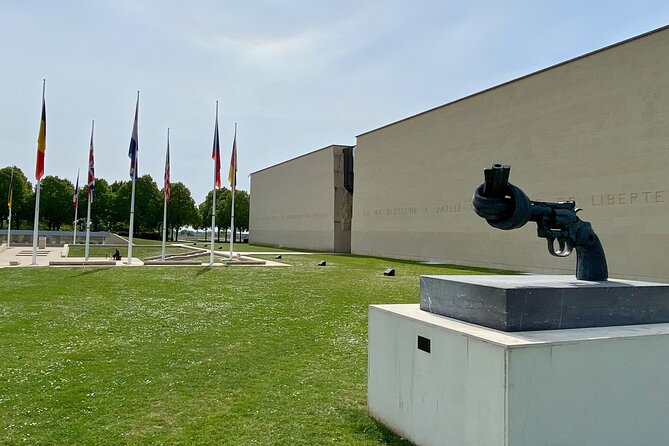
- Caen Memorial and Museum
- Arromanches-les-Bains and the Mulberry Harbour viewpoint
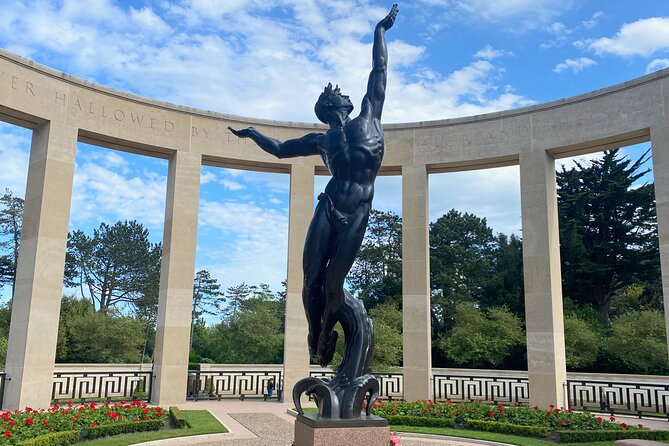
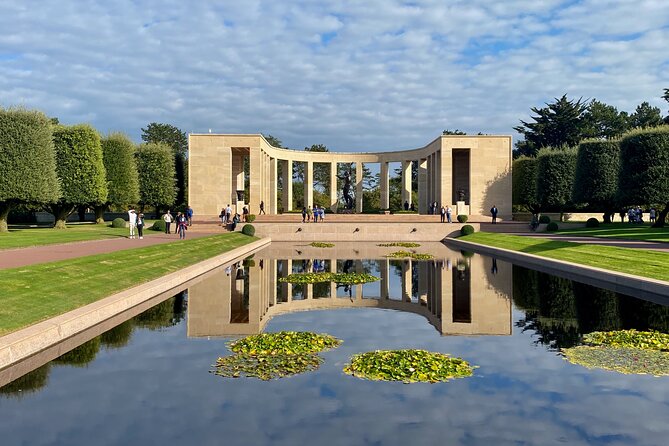
- Normandy American Cemetery and Visitor Center
- Overlord Museum, then Omaha Beach
- Pointe du Hoc: the cliff between Omaha and Utah
- Overnight in Bayeux
- Day 2: Utah Beach, Sainte-Mère-Église, and the Airborne Museum night jumps
- Church Saint-Come-et-Saint-Damien d’Angoville-au-Plain
- Utah Beach Landing Museum and Utah Beach itself
- Sainte-Mère-Église: town stop with the John Steele story
- Airborne Museum: the real show is the scenography
- D-Day Night Jumps experience
- Return to Bayeux for the second night
- Day 3: Mont Saint Michel Abbey, Cabourg, and Calvados Pere Magloire tasting before Paris
- Abbey visit: guided when possible, audio guide when not
- Cabourg stop
- Calvados Pere Magloire L’Experience: learning plus tasting
- Back to Paris
- Mercedes transport and the pace: what it feels like in real time
- Tickets, inclusions, and where the money actually goes
- Who should book this Normandy and Mont Saint Michel combo
- Should you book this tour? A simple decision checklist
- FAQ
- What time is pickup in Paris?
- What kind of vehicle do you use for a private group?
- Is the tour guided?
- What languages is the tour offered in?
- Which key visits are included in the price?
- Are meals included?
- Where do you stay overnight?
- Can I cancel for a full refund?
- Are tickets mobile?
Key points at a glance
- Private Mercedes transport (Mercedes E220 for 2, Mercedes minivan for 3+), with live guidance throughout
- Caen Memorial paired with D-Day beaches like Omaha and Pointe du Hoc, with focused context before you arrive
- Arromanches Mulberry Harbour story plus a 360 Circular Cinema documentary view from the best bay viewpoint
- Church Saint-Come-et-Saint-Damien stop tied to real wartime medics and even preserved blood stains
- Airborne Museum experiences that go beyond exhibits, including C-47 night jump scenography
- Mont Saint Michel Abbey guided when possible, then Cabourg and a Pere Magloire Calvados tasting before returning to Paris
More runs out to Mont Saint-Michel:
- Day Trip to Mont-Saint-Michel from Paris
★ 4.5 · 4,876 reviews - Mont Saint Michel Day Trip from Paris with English Speaking Guide
★ 4.5 · 2,750 reviews - From Paris: Mont Saint Michel Day Trip with a Guide
★ 4.6 · 1,970 reviews - Mont Saint Michel Guided Day Trip with Abbey Entry from Paris
★ 4.0 · 1,254 reviews
Why this Paris to Normandy to Mont Saint Michel route works
This tour is built for people who want history that actually lands. You do not just hop from one battlefield photo spot to another. You get a sequence of viewpoints, museums, and memorials that help your brain connect what you see to what happened.
I also like that it is private. In practice, that means you are not stuck sharing a headset with the whole world. You ride in a comfortable Mercedes E220 if it is just a couple, or a Mercedes minivan for larger groups, and the pace is set around your group. That matters because the Normandy region is spread out. If you are trying to cover Caen, Omaha, Utah, and Sainte-Mère-Église, transport becomes the backbone of the whole trip.
One more thing I appreciate: the tour keeps mixing “big” and “specific.” You go to famous places like the Normandy American Cemetery and Omaha Beach, but you also stop at smaller sites where the details feel personal. That combination is why the days feel intense, but not empty.
Day 1 in the Caen to Omaha corridor: Caen Memorial, Arromanches, and the Atlantic Wall
Day 1 starts early with pickup from your hotel entrance in central Paris. Then you head toward Caen in an air-conditioned Mercedes. The drive is about three hours, with a rest stop along the way, and it is live guided the whole time.
Caen Memorial and Museum
At the Memorial de Caen, you get a guided visit in the British Sword Beach sector. What I like here is the way the museum balances operations with people. You are shown the larger battle arc, but the focus stays on lives impacted by the fighting. A 19-minute film uses original historic footage, which is a strong way to set the tone before you start visiting the beaches.
Practical tip: this is a museum stop, so your comfort matters. If you are the type who gets restless in long indoor exhibits, plan to take breaks only where your guide can pause the group.
Arromanches-les-Bains and the Mulberry Harbour viewpoint
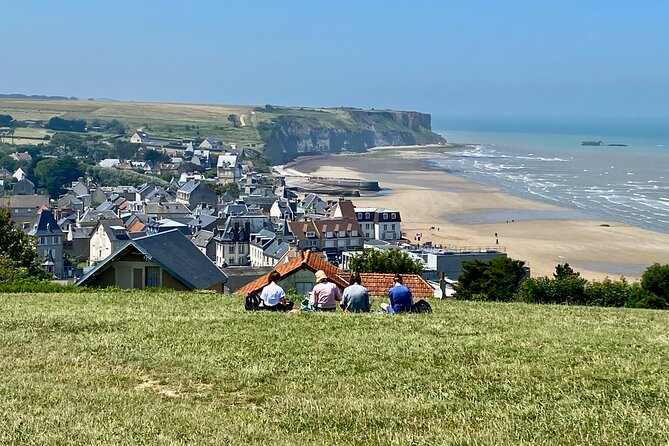
Next you head to Arromanches-les-Bains, a seaside town tied directly to the Allied artificial harbor known as Mulberry Harbour. This is not the kind of fact you remember forever unless you also see the physical setting. The tour builds that connection by including a viewpoint and a film-style experience.
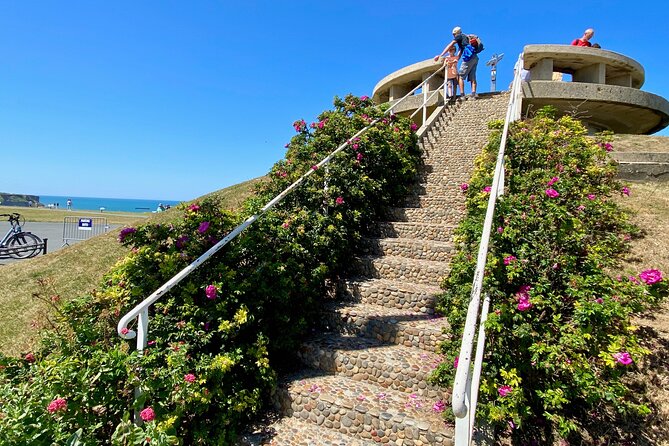
You get a lunch break and then a visit to the 360 Circular Cinema. From the top of the hill, you watch a 360 documentary about the Battle of Normandy and Operation Overlord. When you do this before you see Omaha and Pointe du Hoc later in the day, it helps you understand how landing supplies and logistics became as important as troops.
Arromanches also gets a quick context moment tied to real numbers from the operation, including men, vehicles, and tons of supplies brought in by the harbor during the first days. That kind of detail helps make the beaches feel more than “where the big events happened.”
Other long days to the Normandy beaches:
- Normandy D-Day Sites & Cemetery Day Trip from Paris with Lunch★ 5.0 · 6,877 reviews
- Normandy D-Day Small-Group Day Trip with Omaha Beach, Cemetery & Cider Tasting★ 5.0 · 2,786 reviews
- Normandy D-Day Beaches and American Cemetery Day Trip from Paris★ 4.5 · 2,673 reviews
- Paris: Normandy D-Day Sites Guided Day Trip with Lunch★ 4.7 · 1,082 reviews
Normandy American Cemetery and Visitor Center
After Arromanches, you move to Colleville-sur-Mer for the Normandy American Cemetery & Visitor Center, overlooking Omaha Beach. The cemetery itself is the emotional anchor here. It contains 9,387 U.S. soldiers, with the Wall of the Missing listing names of soldiers missing in action.
There are also visible parts of the story in the landscape. The cliffs leading down to the beaches still include remnants of German defenses, including concrete casemates and memorials. If you are visiting Normandy for the first time, this stop teaches you how to “read” the geography. It is not just an overlook. It is an evidence board for what the land looked like during the fighting.
Overlord Museum, then Omaha Beach
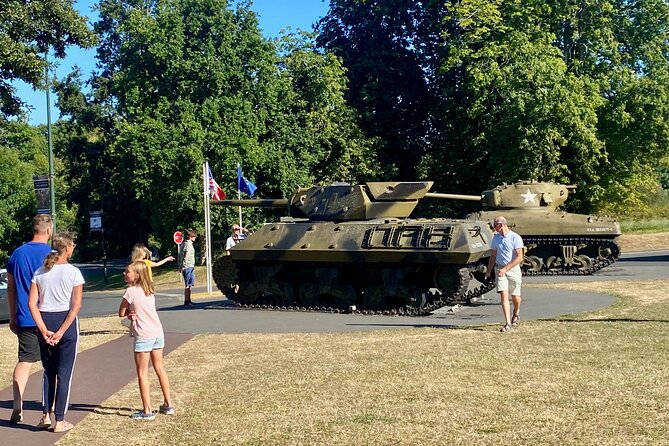
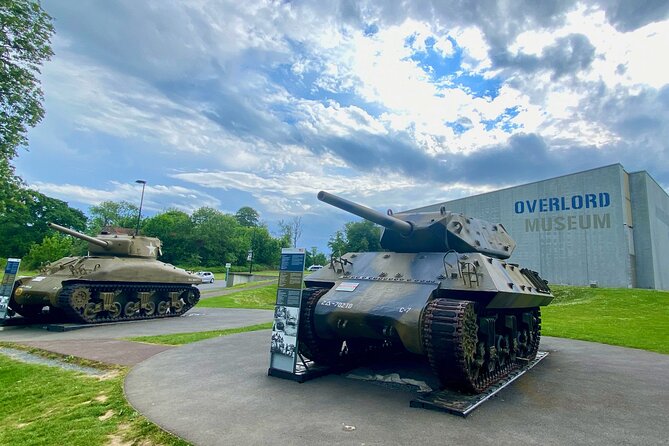
From the cemetery you go to the nearby Overlord Museum, located just a short distance away. This museum is more hands-on and artifact-heavy. You see tanks, weapons, guns, military vehicles, V-1 missile elements, and personal belongings. I like this placement because it gives you context right next to where you are about to stand at Omaha Beach. You are not imagining the scene. You are looking at tools and materials connected to it.
Then it is onto Omaha Beach itself, with a focused visit window. You learn about the sacrifice made by the 34,000 men who landed there on D-Day.
Pointe du Hoc: the cliff between Omaha and Utah
To finish Day 1, you go to Pointe du Hoc, the cliff site between Utah and Omaha beaches. This mattered because it served as a gun battery that could fire on both areas. The tour visits the remaining concrete casemates and bunkers that were part of Hitler’s Atlantic Wall defenses.
You also get the story of the 2nd Ranger Battalion’s role in taking this crucial battery on June 6, 1944. If you can handle just one “wow” moment on the first day, this is often it. The cliffs make you understand why this was hard ground to fight over.
Overnight in Bayeux
Day 1 ends with arrival in Bayeux for an overnight at a 3-star or 4-star hotel, depending on your choice. Staying here matters. It keeps Day 2 from becoming another long drive slog.
Day 2: Utah Beach, Sainte-Mère-Église, and the Airborne Museum night jumps
Day 2 starts with a drive from Bayeux toward Angoville-au-Plain, about 50 km and roughly 40 minutes. Then you head to the heart of the American airborne story around Utah Beach and Sainte-Mère-Église.
Church Saint-Come-et-Saint-Damien d’Angoville-au-Plain
This is one of those stops that sticks with you, not because it is flashy, but because it feels shockingly real. The tour makes a short stop at the Church Saint-Come-et-Saint-Damien where, during the D-Day fighting, medics Robert Wright and Kennith Moore from the 101st Airborne set up a field hospital.
They used the pews of the church as hospital beds. The tour notes that blood stains are still on the pews, and that Germans stormed the church door but left quietly after seeing wounded from both sides treated. A red cross marked the door afterward.
Even if you already know the invasion story, this kind of detail puts a human face on what happened in small places.
Utah Beach Landing Museum and Utah Beach itself
From there you go to the Utah Beach Landing Museum. You also get time to walk and learn at Utah Beach. The tour describes Utah as the next beach west of Omaha, one of the five Normandy D-Day beaches, and notes the first storming happened with 23,000 American soldiers on June 6, 1944, targeting Cherbourg and its deep water port.
You also hear about casualties and the units involved, including the 82nd and 101st Airborne Divisions and several others. On a practical level, this is where the tour’s geography helps you. Utah and Omaha start to feel like a system, not isolated headlines.
At the Landing Museum, the highlight is built around a former German bunker and a collection of historical artifacts, military vehicles, and the original B26 bomber. The museum slot is long enough that it does not feel like a drive-by.
Sainte-Mère-Église: town stop with the John Steele story
Then you head to Sainte-Mère-Église, first as a short stop in front of the Airborne Museum. This town played a key part early in the invasion, because airborne units occupied it during Mission Boston.
You learn the story of paratrooper John Steele of the 505th Parachute Infantry Regiment, a figure that inspired the film The Longest Day, shot in the village in 1961. The mannequin placed on the church steeple is still there as tribute.
The tour also points out the Borne 00 milestone, tied to Theodore Roosevelt Jr. landing and deciding to lead the assault from there.
Airborne Museum: the real show is the scenography
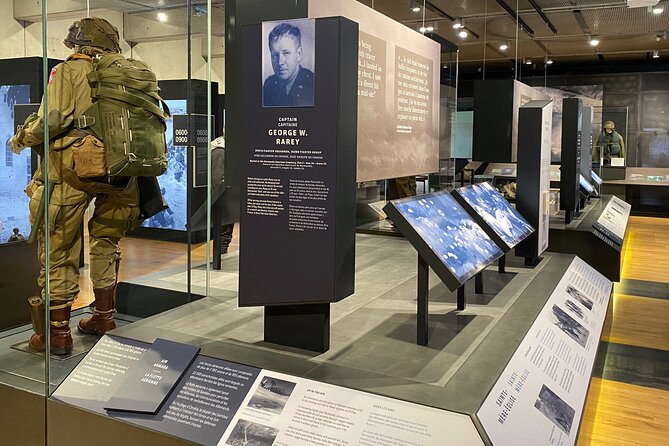
The Airborne Museum visit is a highlight. It is designed around the U.S. paratroopers of the 82nd and 101st Airborne Divisions, spread across multiple buildings, including two that resemble open parachutes.
You get aircraft and a tactile, interactive element described through touch pads. There is also the WACO building for gliders, including the only copy of a WACO glider in France. The museum experience includes joining soldiers in a glider setup just before takeoff moments.
The central C-47 building is a big scenography moment, with suspended parachute displays and realistic statues, anchored by the original C-47 aircraft. This is not just looking at objects. It is structured to make you feel the sequence of loading and deployment.
D-Day Night Jumps experience
The tour then includes the D-Day Night Jumps portion in hyperrealist museography. You experience nighttime embarkation of a C-47 aircraft in England, then a drop into Sainte-Mère-Église square during fighting, followed by operations. You also encounter an American reconnaissance plane, a Piper Cub.
This is the point in the trip where the “history” framing shifts into something more visceral. If you want the invasion to feel like a mission, not a timeline, this is where it clicks.
Return to Bayeux for the second night
After the museum, you drive back to Bayeux. There is a rest stop along the way again, and the hotel stay sets you up for the Mont Saint Michel day.
Day 3: Mont Saint Michel Abbey, Cabourg, and Calvados Pere Magloire tasting before Paris
Day 3 begins with the drive from Bayeux to Mont Saint Michel, about 130 km and roughly 1.5 hours. Then the day turns from battlefield to pilgrimage town, which gives your brain a needed reset.
Abbey visit: guided when possible, audio guide when not
At the Abbaye du Mont-Saint-Michel, the tour typically aligns with the abbey’s own guided visit. If that guided slot is not possible, you get audio-guides.
Either way, you go up from the medieval village streets toward the abbey on the top of the island. From there you get panoramic Atlantic Ocean and bay views. The tour notes first settlement in 709, then focuses on the Benedictine abbey construction starting in the 700s and continuing through the 1200s.
This is one of those places where a guide-driver matters. Mont Saint Michel can be a maze of footpaths. Having the group directed up the narrow streets makes it feel manageable, even if you are surrounded by tourists.
After the abbey visit, you get free time in Mont Saint Michel for the town and lunch.
Cabourg stop
Then you head to Cabourg. The tour includes time to arrive, visit town briefly, and break up the drive.
Calvados Pere Magloire L’Experience: learning plus tasting
In Pont-L’Evêque, you visit Calvados Pere Magloire L’Experience. You learn how Calvados has been made for centuries, and then you get a tasting with explanations. This is a nice send-off after two intense days of war-related sites.
Even if you are not a big spirits person, it is a structured cultural stop. You get the story of production rather than just sampling without context.
Back to Paris
Finally, you drive back to Paris, about 2.5 hours, and you are dropped off at your hotel. The day is long, but it ends with a direct ride home rather than the stress of transfers on your own.
Mercedes transport and the pace: what it feels like in real time
This is where private tours can either feel luxurious or feel exhausting. In this case, the Mercedes setup helps. Your transportation is air-conditioned, and you move between zones in a more comfortable way than bus travel, especially on days with multiple stops.
The schedule is clearly built around time blocks at major sights. That means fewer long gaps where you wander alone wondering what to do next. But it also means less floating time. You will have short time windows for free strolling, such as time at Utah Beach and lunch breaks, but do not expect to linger for hours without moving.
The good news: because the tour is live guided, those time windows usually feel purposeful. You know what to look for when you step out of the vehicle, instead of just trying to recognize plaques and maps.
Tickets, inclusions, and where the money actually goes
The tour price is $2,454.57 per person, and private tours at this level often feel easier to justify when you understand what is included.
What you get included (high impact items) covers major museums and memorial sites across both Normandy and Mont Saint Michel. That includes:
- Memorial de Caen and museum time
- 360 Circular Cinema in Arromanches
- Overlord Museum near Omaha
- Normandy American Cemetery & Visitor Center
- Utah Beach Landing Museum
- Airborne Museum, including the night jumps experience
- Mont Saint Michel Abbey visit and time in the medieval village area
- Calvados Pere Magloire L’Experience with tasting
- Hotel accommodations for two nights with breakfast in double rooms
- A Mercedes E220 or Mercedes minivan, depending on group size, plus live guidance
Meals are not included, and there are specific lunch breaks in the schedule. That is fairly standard for this kind of tour, but it is worth planning for, especially if you want a sit-down lunch rather than grabbing something quick.
Gratuities and souvenirs are also not included, so budget a little extra if you are the tipping type.
My value take: you are paying for (1) private door-to-door transfers, (2) a tight historical flow that reduces decision fatigue, and (3) paid entry experiences stacked across three days. If you are already convinced you want Omaha, Utah, Sainte-Mère-Église, plus Mont Saint Michel, this bundle-style private approach can be efficient.
Who should book this Normandy and Mont Saint Michel combo
This tour fits best if you:
- Want to see multiple D-Day zones, not just one beach
- Like a guided history approach with museums and memorials tied together
- Prefer private transport that starts at your hotel door
- Want a mix of intense sites and a cultural finale with Mont Saint Michel and Calvados
It might not fit if you:
- Hate early starts or packed days
- Want lots of downtime or long, independent exploring between stops
- Are traveling purely for light sightseeing and not for museums and historical detail
One extra thought: the tour is offered in English, and the format says most travelers can participate. If your group includes folks who struggle with language barriers, the live guidance and structured museum visits can make the trip feel easier.
Should you book this tour? A simple decision checklist
Book it if you want a guided, private, high-coverage route that connects the Normandy battle story from Caen to Omaha to Utah, then finishes at Mont Saint Michel with Calvados.
Maybe skip or look for a slower option if you are the type who needs long breaks between stops, or if you want the trip to be more about personal wandering and less about tightly scheduled sights.
Either way, the key is knowing what kind of traveler you are. This tour is for people who want maximum meaning per day, and who are happy trading free time for clarity and momentum.
FAQ
What time is pickup in Paris?
The start time is listed as 7:00 am, and pickup is from the entrance door of your hotel.
What kind of vehicle do you use for a private group?
You use a Mercedes E220 business-class car for 2 people, or a Mercedes minivan for 3 participants and more.
Is the tour guided?
Yes, it is live guided with a guide-driver or driver and guide.
What languages is the tour offered in?
The tour is offered in English.
Which key visits are included in the price?
Included visits cover the Caen Memorial and Museum, Omaha Beach area sites including the Normandy American Cemetery and Overlord Museum, the 360 Circular Cinema at Arromanches, the Airborne Museum experience including D-Day Night Jumps, Utah Beach Landing Museum, Mont Saint Michel Abbey visit, and Calvados Pere Magloire L’Experience with tasting.
Are meals included?
Meals and drinks are not included. There are lunch breaks built into the schedule, but you will pay for your meals.
Where do you stay overnight?
You stay overnight in Bayeux for two nights, in a 3-star or 4-star hotel option with breakfast, in double rooms.
Can I cancel for a full refund?
Yes. Free cancellation is available, and you can cancel up to 24 hours in advance for a full refund.
Are tickets mobile?
Yes, the tour includes mobile tickets.
Newest write-ups from Paris




D-Day Landing Beach Day Trips, compared.

Normandy D-Day Sites & Cemetery Day Trip from Paris with Lunch
Read our review →
Normandy D-Day Small-Group Day Trip with Omaha Beach, Cemetery & Cider Tasting
Read our review →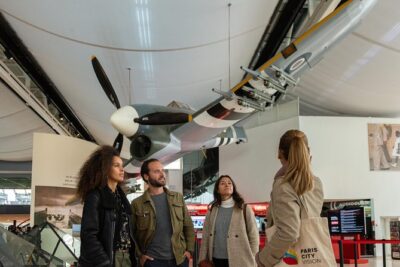
Normandy D-Day Beaches and American Cemetery Day Trip from Paris
Read our review →
Normandy D-Day Sites Guided Day Trip with Lunch
Read our review →
Normandy D-Day Beaches with Juno Beach, bunkers & Canadian Cemetery from Paris
Read our review →
Normandy D-Day Landing Beaches Small-Group Day Trip from Paris
Read our review →
Normandy 2Days Trip Landing Beaches and Mont St Michel from Paris
Read our review →Browse the lists this tour appears in