
Reviewed · SEINE CRUISES
Live, Laugh, Love Along the Seine: Self-Guided Romantic Tour
Romance meets a puzzle game on the Seine. This self-guided route turns a simple walk into an interactive history hunt from the Arc de Triomphe du Carrousel to the Left Bank, with offline play and no map, GPS, or internet needed. I also like that you can pause whenever you want, day or night, then keep going later.
The main drawback is also the biggest tip: you need to read carefully and slow down at the clue steps, because rushing can send you to the wrong place.
In This Review
- Key points to know before you go
- A romantic game along the Seine, without the usual tour pressure
- Price and time: why $7.21 works for a 2-hour Paris walk
- From Arc de Triomphe du Carrousel to the Louvre pavilions
- Pont des Arts and the riverfront bridge pause
- Left Bank café line-up: Ladurée, Café de Flore, Les Deux Magots
- Saint-Germain-des-Prés to Procope: churches and coffeehouse legends
- Fontaine Saint-Michel, Shakespeare and Company, and the bookish side of the Seine
- Notre-Dame, Conciergerie, Pont Neuf, and Île de la Cité finale
- How to play well: pacing, reading clues, and staying on track
- Who this Seine romantic self-guided game suits best
- Should you book Live, Laugh, Love Along the Seine?
- FAQ
- Is this a guided tour with a person?
- Do I need internet or GPS to play?
- How long is the experience?
- What language is it offered in?
- Where do I start and where does it end?
- Can I start at any time during the day?
- Is this private or shared with other groups?
- Do I need a physical ticket?
- Can I cancel for a full refund?
Key points to know before you go
Offline, no-GPS game: You play without internet, and you do not need to bring a paper map.
Flexible timing and pacing: Start any hour within the daily window, take breaks, then resume later.
Private experience, no guide contact: It is set up for just your group, which keeps it calmer and easier to enjoy.
A classic Paris mix of icons and streets: You cover the Seine riverfront and also the Left Bank café circuit.
Short challenges at major sights: Many stops are designed as quick moments, about 5 minutes each.
Great value for two hours: At $7.21 per person, it is a low-cost way to add structure to a romantic stroll.
More boats along the Seine:
- Paris: 1-Hour Seine Cruise departing from the Eiffel Tower
★ 4.4 · 77,472 reviews - Paris: Seine Cruise & Crepe Tasting near the Eiffel Tower
★ 4.4 · 11,231 reviews - Paris: Seine River Panoramic Views Dinner Cruise
★ 4.3 · 10,611 reviews - Paris: Eiffel Tower Access by Elevator & Seine River Cruise
★ 4.6 · 7,329 reviews
A romantic game along the Seine, without the usual tour pressure
Paris is best when you get to wander, but it is also best when you have a reason to stop and look. This experience does both by giving you an interactive game format while you move along the river and through the Left Bank. You are not herded into a schedule, and you are not stuck waiting on a group.
What makes it feel especially romantic is the setting. The route naturally threads together bridges, cafés, and major landmarks, so the romance comes from the walk itself, not from a scripted speech. And because it is self-guided, you can take the kind of pauses couples love, longer photo stops, or a quick break to reset your brain before the next clue.
I also appreciate the low-friction vibe. Since there is no need for GPS or internet connectivity, you are less tied to your phone screen and more tied to what is right in front of you. That is how you end up noticing details like architectural styles, the way light falls on stone, and the rhythm of the streets along the Seine.
Price and time: why $7.21 works for a 2-hour Paris walk
At $7.21 per person for about 2 hours, the value is in how much you get without paying for transportation or guided entry tickets. Most of the stops are listed as free admission, and the time is short enough to fit into almost any Paris day without feeling like you sold your afternoon to a tour.
You also get an experience that is not just sightseeing, it is sightseeing with a “next step” built in. That matters, because Paris can feel endless when you are deciding what to do. A game format gives you momentum, but not so much structure that you lose your freedom.
One practical note: since the whole thing is walking, comfortable shoes matter. If you plan this during your longest walking day, it can still work, but you will want energy. The route also spreads across well-known areas, so it helps to be ready for crowds near the biggest landmarks, even though this is private.
From Arc de Triomphe du Carrousel to the Louvre pavilions
You start at Arc de Triomphe du Carrousel (Pl. du Carrousel, 75001). This is a strong way to begin, because it immediately drops you into the Napoleonic layer of Paris. The arch, built by Percier and Fontaine around 1806 to 1808, was designed to celebrate Napoleonic victories of 1805 and originally meant to serve as a monumental entrance to the Tuileries palace.
The palace burned in 1871, and afterward the arch kept its importance because it still worked beautifully on its own. It also opened up an exceptional view down toward the Champs-Élysées. In the game, you are prompted to look around to find the answer to the first challenge and move on to the next location. The key is to treat this first stop as a warm-up, not a race.
Very shortly after, you continue toward the southern limb of the New Louvre along the Quai François Mitterrand. The focus here is specific: five major pavilions running east to west, the Pavillon de la Lesdiguieres, Pavillon des Sessions, Pavillon de la Tremoille, Pavillon des États, and Pavillon de Flore.
This is a fun section because it turns a line of large buildings into a scavenger hunt. Instead of looking at the Louvre only as a distant icon, you get to pay attention to the structure of the river-facing frontage. It is also a good place to steady your pace, because at this point you understand how the game asks you to look.
Pont des Arts and the riverfront bridge pause
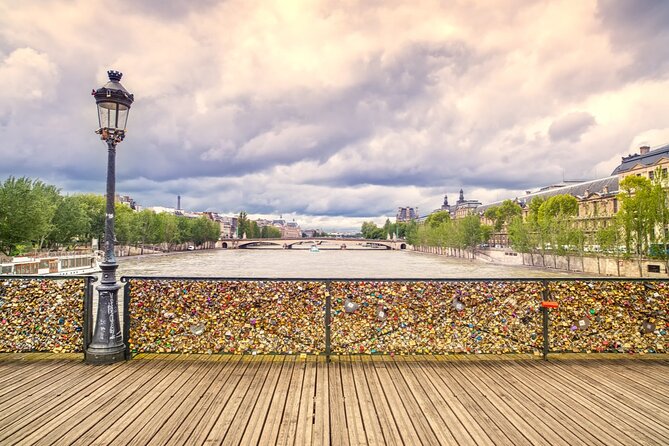
Next up is Pont des Arts, one of the most famous bridges in Paris. It was built between 1802 and 1804 under the empire of Napoleon L, and it links the Institut de France and the Palais du Louvre. The pairing matters: the bridge is not just a crossing, it is a connector between cultural institutions along the Seine.
When you reach the clue step here, the game pushes you into a short, focused look around the bridge area. You are not stuck standing in one spot for long, but you do get a built-in reason to pause, take a photo, and then move on. It is one of those sections where you can quietly enjoy the views because the challenge times are short.
If you like your Paris moments to feel cinematic, this is the area to slow down. The walk along the river and the sense of alignment between landmarks makes it easy to picture what people have been seeing here for centuries.
More of Paris walked without a guide waiting:
- Paris: Illuminations River Cruise with Audio Commentary★ 4.3 · 12,340 reviews
- Paris: Orsay Museum Entry Ticket and Digital Audio Guide App★ 4.4 · 3,170 reviews
- From Paris: Giverny Day Trip with Audio Guide or Live Guide★ 4.3 · 2,372 reviews
- Giverny and Monet’s House Half Day Trip from Paris Guide or Audio★ 4.0 · 1,319 reviews
Left Bank café line-up: Ladurée, Café de Flore, Les Deux Magots
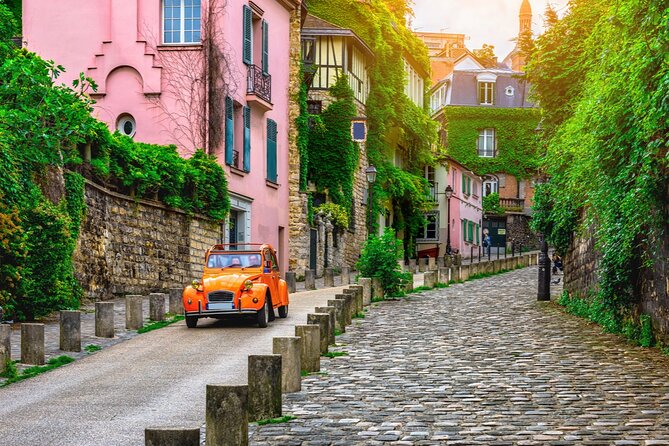
After the riverfront, the route swings into the Left Bank café world. It is a smart move for a romantic game, because cafés are where conversation naturally happens. And these stops are not random names either, they come with quick historical hooks you can actually use while you look.
You start with Ladurée le Bar. The Ladurée family story begins in 1862, when Louis Ernest Ladurée created a bakery in Paris at 16 rue Royale. That small detail gives you a different angle on the modern brand, you are not just seeing a popular spot, you are walking through a family history that starts as a bakery.
Then you head to Café de Flore, founded during the Third Republic in 1887. It is named after a sculpture of Flora, the goddess of flowers and spring, which stood on the opposite side of the boulevard. Even if you do not go inside, you get a reason to look at the café frontage and feel the atmosphere that made it a social landmark.
Next is Les Deux Magots, named after two Chinese figurines that came from a novelty shop that once occupied the premises. The café itself traces back to 1812 at 23 Rue de Buci, and later moved to Place St-Germain-des-Prés in 1873. Those two statues are treated as witnesses to that era, so the game’s prompt to look around helps you notice the details that most people skip.
This is also where the game format shines. You are moving through iconic names, but you are doing it with small “find the answer” tasks that keep you engaged without turning it into a checklist drill. It is playful, and it pairs well with the kind of wandering that comes with love and laughter.
Saint-Germain-des-Prés to Procope: churches and coffeehouse legends
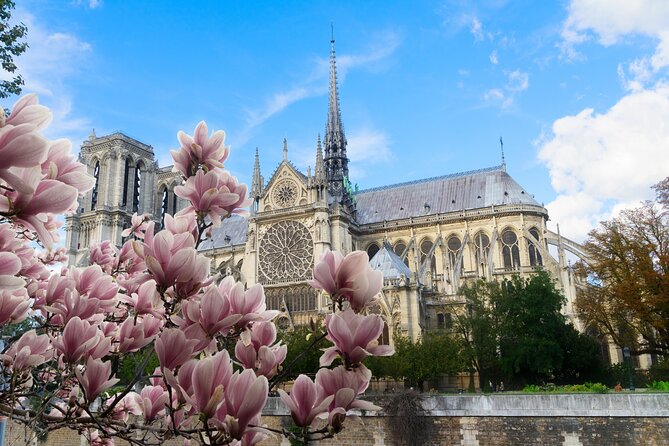
The walk continues into Saint-Germain-des-Prés, anchored by the Église de Saint-Germain-des-Prés, the abbey church that remains today. It is listed as one of the oldest churches in Paris, and the background detail here is specific: in 542, Childebert raised his siege of Zaragoza after hearing the inhabitants had placed themselves under the protection of Saint Vincent.
This clue step is a good reminder that Paris landmarks are layered, not just decorative. When you stop and look with a prompt in mind, you start noticing what makes one religious building different from another.
Right after that, you pass Procope, one of the most historic coffeehouse names associated with this part of Paris. It was first founded in 1686 by Francesco Procopio dei Coltelli, originally from Palermo, Sicily, who opened a coffee house on the Rue des Fosses Saint-Germain, where the restaurant still located.
Even if coffee is not your thing, Procope works in the game because it connects a place name to a founder story. That is the style of learning here, short, factual, and tied to what you can see and read around you.
Fontaine Saint-Michel, Shakespeare and Company, and the bookish side of the Seine
As the route continues, you hit Fontaine Saint-Michel in Place Saint-Michel. This is a monumental fountain constructed in 1858 to 1860 during the French Second Empire by architect Gabriel Davioud. It has been listed since 1926 as a monument historique by the French Ministry of Culture.
The game challenge at this stop is another “look around and answer” moment, which is ideal here because fountains are full of visual detail. If you are the type who enjoys architecture or just likes noticing symbolism, this is a satisfying stop.
Next comes Shakespeare and Company, an English-language bookshop on the banks of the Seine, opposite Notre-Dame. It opened in 1951 and became a meeting place for anglophone writers and readers, eventually turning into a Left Bank literary institution.
For a romantic walk, this is a great pause because it is quiet in a different way than churches or bridges. Even just standing outside with the sense of that literary tradition helps you slow down and feel the Left Bank mood.
This section is also useful for couples because it naturally fits different temperaments. One person can enjoy the sights and street energy, and the other can enjoy the bookshop vibe without needing a formal tour speech.
Notre-Dame, Conciergerie, Pont Neuf, and Île de la Cité finale
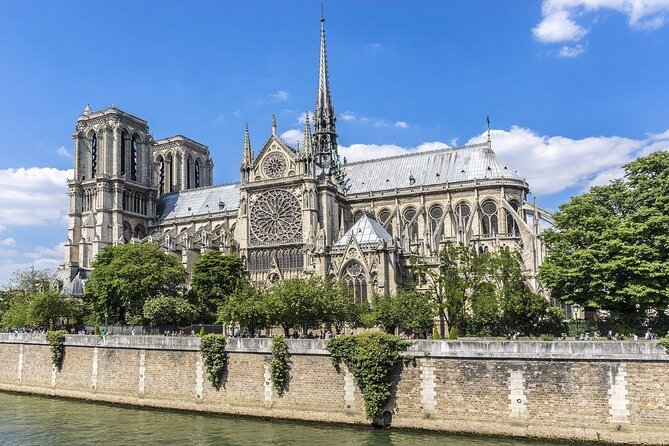
You then move into the heart of old Paris with Notre-Dame de Paris. It is described as a medieval Catholic cathedral on the Île de la Cité, consecrated to the Virgin Mary, and considered one of the finest examples of French Gothic architecture. The game pushes you to stop, look around, and answer a clue before continuing.
After Notre-Dame, the route goes to Conciergerie, a building west of the Île de la Cité. It used to be part of the former royal palace called Palais de la Cité, and it includes the Conciergerie, Palais de Justice, and the Sainte-Chapelle. The building is described as formerly a prison and now used mostly for law courts.
That prison-to-law-courts contrast gives the walk a different tone. It is not just pretty architecture now, it is the weight of how history lived in the space.
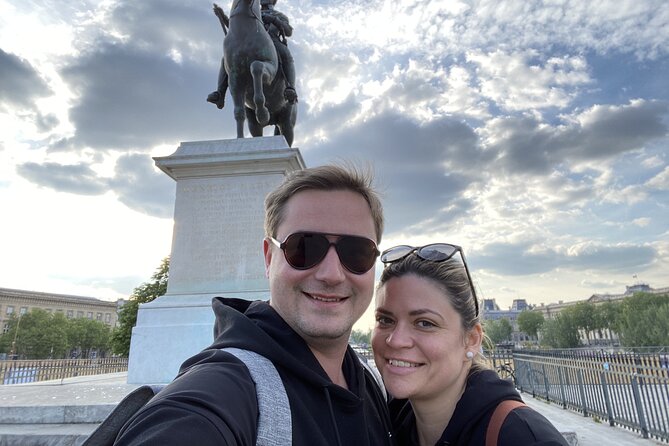
Then you pass the equestrian statue of Henry IV, the bronze equestrian statue completed by Pietro Tacca. It stands on Pont Neuf, and the statue was indirectly commissioned by Marie de Médicis for her husband, King Henry IV of France.
This is where the route feels like it is closing a loop. You started at a Napoleonic arch, and now you are back in a classic royal Paris alignment, circling through the Seine era by era.
The last stretch focuses on the island itself, the Île de la Cité. The information here ties the island’s story to its origins: it was once a Celtic settlement inhabited by a tribe called the Parisii, which is linked to the city’s modern name. You finish at 1 Square du Vert Galant.
If you want the most romantic payoff, keep your pace steady here. The final island section is the right place to end the game feeling like you did more than see landmarks, you understood them in small connected steps.
How to play well: pacing, reading clues, and staying on track
This game is designed for flexibility, and it works best when you use that flexibility. You can take breaks, and you do not need to complete everything in one continuous stretch. You can also play during the day or at night, as long as you stay within the listed daily window of 5:00 AM to 9:00 PM.
The biggest practical skill is attention. The game challenges rely on you looking around for answers, so rushing costs you time. One common mistake is leaving a clue step before you understand what you are supposed to find. If you ever feel unsure at a stop, pause, reread, and then move.
Here is what I recommend to keep it smooth:
- Go slow at the first two clue steps so you get the hang of the style.
- Take photos after you solve each clue, not before. It keeps you focused on the look-around part.
- Keep your phone power in mind. Even though it runs offline, your battery still matters when you are outside.
- Wear shoes you can stand in. Since you can pause and resume, you can stretch a stop if you want more time to take photos or just watch the street life.
Also remember the experience is private, with only your group participating. That means you can keep your own rhythm without worrying about matching everyone else’s pace.
Who this Seine romantic self-guided game suits best
This experience fits best if you like Paris at walking speed and you enjoy small missions. It is not a lecture tour. It is more like, I will wander the Seine with purpose, and every few minutes I get a reason to stop.
It is also ideal if you want a date plan that feels lively but not complicated. The cafés and literary stop create natural conversation points. And because you can pause whenever you want, you can add your own romantic ingredients like a longer sit or a quick snack break.
If you are traveling with a family, it can work well too, as long as everyone in your group is willing to follow directions and read prompts. The experience length is short enough to stay manageable, around two hours.
Finally, it is a good choice for travelers who hate getting lost but also hate being stuck in a rigid tour schedule. You do not need GPS, and you do not need a guide walking beside you. You get structure without the babysitting.
Should you book Live, Laugh, Love Along the Seine?
Yes, I think you should book it if you want a romantic, low-cost, structured walk through classic Paris scenes. The best reasons are simple: offline play, short clue steps, and a route that mixes the Seine, major landmarks, and the Left Bank café and bookshop feel.
I would only hesitate if you know you get frustrated by reading instructions outdoors or you dislike walking between multiple famous spots. In that case, the pacing might feel like work instead of play. But if you are the type who likes solving little puzzles and looking closely, you will probably enjoy how the city’s history shows up in small, memorable ways.
If you want to make it even better, plan it as a mid-day or early evening stroll when you can take your time at the landmarks. Start at the morning end if you want quieter streets, or later if you want the Seine to feel more atmospheric.
FAQ
Is this a guided tour with a person?
No. It is a private, self-guided activity with no physical tour guide.
Do I need internet or GPS to play?
No. You can play offline, and the experience does not require map, GPS, or internet connectivity.
How long is the experience?
It lasts about 2 hours.
What language is it offered in?
It is offered in English.
Where do I start and where does it end?
It starts at Arc de Triomphe du Carrousel, Pl. du Carrousel, 75001 Paris, France. It ends at 1 Square du Vert Galant, 75001 Paris, France.
Can I start at any time during the day?
Yes. You have full flexibility to start at any hour, take a break, and resume later. The listed opening hours are Monday to Sunday from 5:00 AM to 9:00 PM.
Is this private or shared with other groups?
It is private. Only your group will participate.
Do I need a physical ticket?
It uses a mobile ticket.
Can I cancel for a full refund?
Yes. Free cancellation is available, and you can cancel up to 24 hours in advance for a full refund.
Newest write-ups from Paris



Seine Cruises, compared.
1-Hour Seine Cruise departing from the Eiffel Tower
Read our review →
Seine Cruise & Crepe Tasting near the Eiffel Tower
Read our review →
Eiffel Tower Access by Elevator & Seine River Cruise
Read our review →
3-Course-Dinner Cruise on the Seine with live music
Read our review →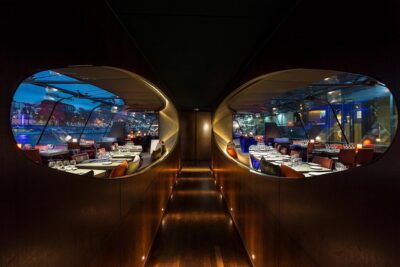
Bateaux Parisiens Seine River Gourmet Dinner & Sightseeing Cruise
Read our review →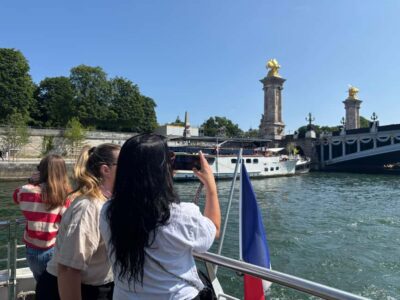
Hop-On Hop-Off Seine Cruise Pass with 9 Stops
Read our review →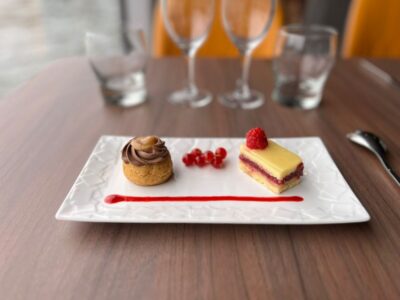
Browse the lists this tour appears in