
Reviewed · D-DAY LANDING BEACH DAY TRIPS
Pointe du Hoc,Omaha Beach, American Cemetery – Day trip from Paris to Normandy
Rangers climbed these cliffs for a reason. This full-day, small-group WWII trip from Paris puts you right where the fighting happened, with a guide who connects the dots from Pointe du Hoc to Omaha Beach.
What I like most is the pace and focus. You get a private, air-conditioned minivan ride with a guide (the standout in this tour is Regis in many bookings), and the day is built around the key locations without feeling like you are sprinting. One real consideration is timing: the start is early, and the full day runs about 13 to 14 hours, so you should come ready for a long, meaningful day.
In This Review
- Key highlights you will feel in real life
- Why this Normandy day trip makes sense from Paris
- Morning logistics: the 6:30am start and the long drive both ways
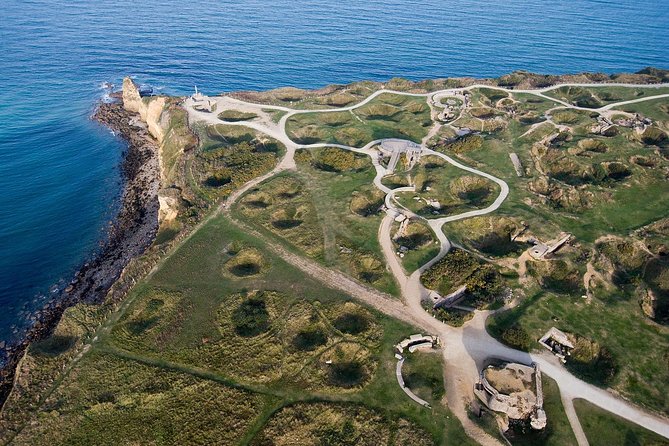
- Pointe du Hoc: the cliffs, the 155mm guns, and the scale of the mission
- From WN72 to the Omaha sectors: monuments that help you picture the battlefield
- Omaha Beach on foot: the strongest resistance nest and the 1st US Infantry Division memorial
- Overlord Museum: where the landing becomes understandable in objects and reconstructions
- The American Cemetery at Colleville-sur-Mer: order, names, and quiet impact
- Arromanches and the Mulberry harbour remains: the landing’s supply system
- Price and value: what you get for $326.53 per person
- Who should book this tour, and who might not love it
- Quick practical tips to make the day better
- Should you book this tour?
- FAQ
- How long is the Paris to Normandy day trip?
- What time does the tour start in Paris?
- How many people are in the group?
- What are the main stops on the tour?
- Is museum admission included?
- Is lunch included in the price?
- What language is the tour offered in?
- Where does the tour meet, and when does it end?
- What happens if the weather is poor?
Key highlights you will feel in real life
- Pointe du Hoc’s cliff-top gun batteries, still visibly scarred by 1944 blast marks and craters
- Omaha Beach sector landmarks you can place on the map in your head, not just on a big photo
- Overlord Museum included, with personal items and reconstructed vehicles and tanks
- The American Cemetery at Colleville-sur-Mer, perfectly ordered, with names preserved on the Walls of the Missing
- Arromanches and Mulberry harbour remains, where the supply effort that powered the landing is explained clearly
- A maximum-small group size, which makes it easier to ask questions and move at the right speed
Other long days to the Normandy beaches:
- Normandy D-Day Sites & Cemetery Day Trip from Paris with Lunch
★ 5.0 · 6,877 reviews - Normandy D-Day Small-Group Day Trip with Omaha Beach, Cemetery & Cider Tasting
★ 5.0 · 2,786 reviews - Normandy D-Day Beaches and American Cemetery Day Trip from Paris
★ 4.5 · 2,673 reviews - Paris: Normandy D-Day Sites Guided Day Trip with Lunch
★ 4.7 · 1,082 reviews
Why this Normandy day trip makes sense from Paris
A Normandy landing day can be done many ways, but the best version is the one that protects your attention. This tour does that by building the schedule around fewer stops, each with enough time to look, listen, and understand.
The other big win is the group size. With a maximum of 7 people, you are not lost in a crowd. You also get more back-and-forth in the car, and the guide can adjust when questions pop up.
Morning logistics: the 6:30am start and the long drive both ways
You meet at Théâtre du Lido, 116 bis Av. des Champs-Élysées, right by the Champs-Élysées, and the day starts at 6:30am. The ride is long, and you should plan on several hours to reach the Omaha area, with a similar return in the late evening.
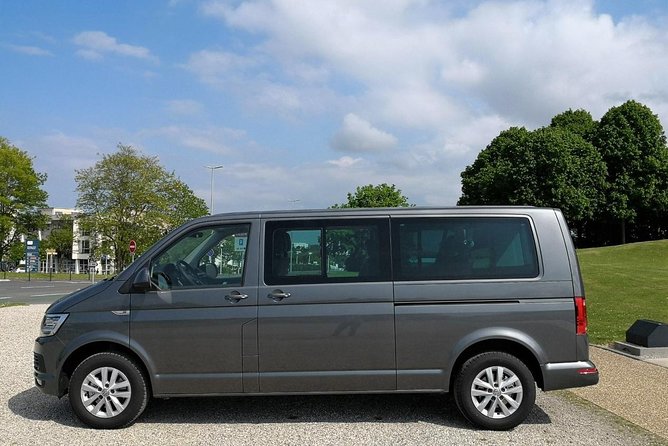
The comfort matters here. The tour uses an air-conditioned minivan and keeps you moving without the stress of rental-car navigation on unfamiliar roads. One practical detail I love: a guide can set expectations along the drive so you get your bearings fast before you ever step onto the beach.
Pointe du Hoc: the cliffs, the 155mm guns, and the scale of the mission
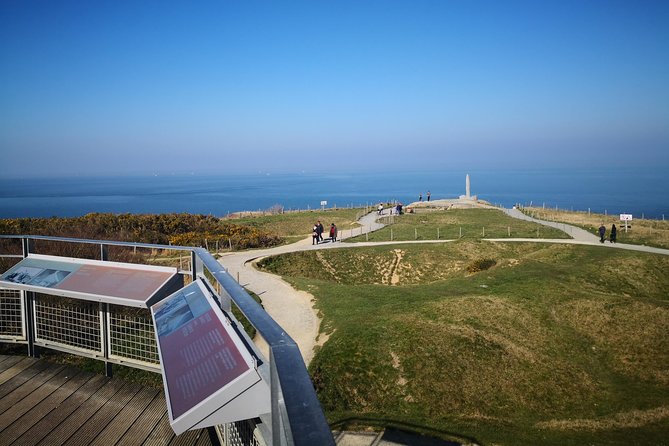
Pointe du Hoc is the stop that usually grabs people by the collar. It is a high cliff position above the English Channel, between Omaha and Utah beaches, where German long-range artillery was set into concrete bunkers.
Standing there, the story becomes physical. In mid-1943 the guns were installed in heavily reinforced shelters, part of the Atlantic Wall defensive system Hitler planned along the coast. Then on June 6, 1944, US Rangers landed below the cliffs and scaled them using ropes, racing to destroy the gun emplacement before it could keep firing.
What makes this stop special in a guided setting is that you are not just reading labels. You are looking at the landscape and being shown what you are seeing: blown-up concrete sections, bomb craters, and traces of battle that are still visible today.
Time on site is about 40 minutes. That is enough to take in the view, absorb the key moments, and walk the viewpoint areas at a steady pace, rather than rushing straight through.
From WN72 to the Omaha sectors: monuments that help you picture the battlefield
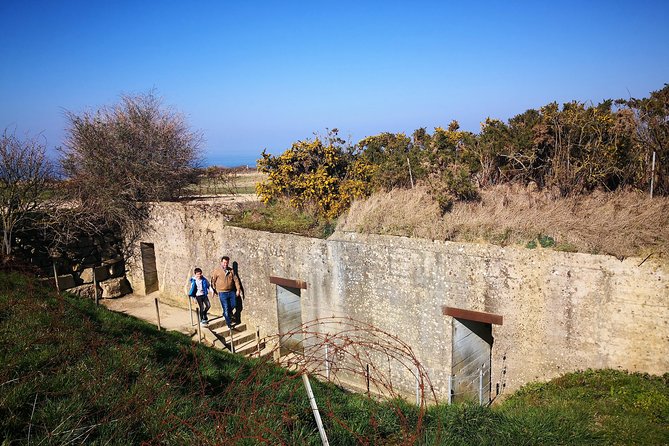
Next you visit the National Guard Monument, on the spot labeled WN72, where the 29th National Guard Division broke through German defenses on D-Day. This is one of those places where a monument plus the right context changes everything. Without direction, you might think you are just looking at stone and grass. With the right explanation, it becomes a pinpoint in a much larger story.
Then the tour moves into Omaha Beach, and the guide ties the coastline to the American units involved. At the Easy Green sector area, you stop for photo moments at two monuments:
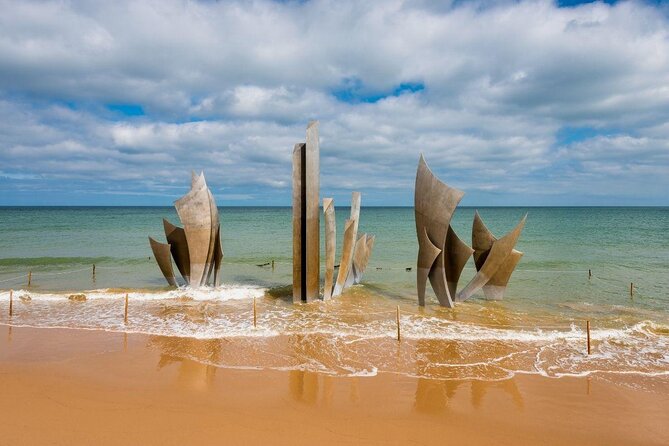
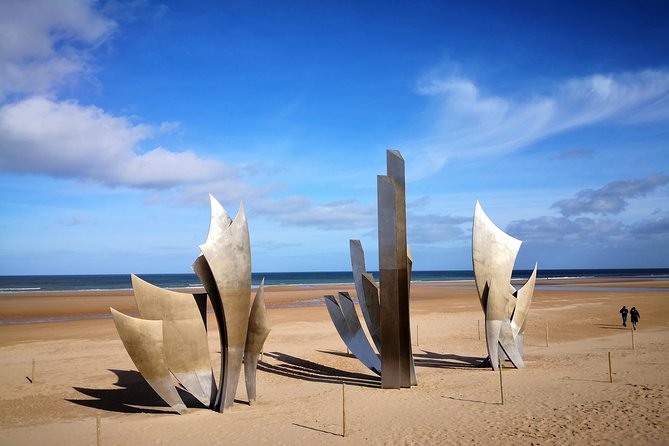
- Signal of the Liberation, with frescoes linked to the 1st US Infantry Division and the 116th Regimental Combat Team of the 29th US Infantry Division
- The Braves, a sculpture by Anilore Banon that focuses on Allied courage
If you want a souvenir that feels appropriate, this is also one of the moments where you can walk the beach and collect a bit of sand in a tiny container. One small tip from the field: bring a container if you have one, since the guide may provide something to help you gather sand.
Time here is short, about 20 minutes, so treat it as a springboard. The real payoff comes when you connect these monuments to what you see later at the cemetery and the museum.
A handful more Paris options to weigh up
- Disneyland® Paris 1-Day Ticket★ 4.6 · 49,412 reviews
- Day Trip to Mont-Saint-Michel from Paris★ 4.5 · 4,876 reviews
- Disneyland® Paris 1-Day Flexible Date Ticket★ 4.3 · 4,347 reviews
- Loire Valley Castles Day Trip from Paris with Complementary Wine★ 4.5 · 3,907 reviews
Omaha Beach on foot: the strongest resistance nest and the 1st US Infantry Division memorial
Omaha is not one simple beach. It is multiple sectors, with different defensive strongpoints and units. That is why the stop at the Memorial of the 1st US Infantry Division matters.
The obelisk sits at the Wiederstandsnest area, WN62, which overlooks the Easy Red and Fox Green sectors. This position was described as the most powerful resistance nest on the Omaha coastline stretch.
On a guided day, you are not just walking near the water. You are learning to orient yourself along the coastline and understand how that landscape affected the fight. You are also getting a clearer picture of why some points were harder to take than others.
This stop is about 30 minutes. Use that time to look up and down the coastline from where you are standing, even if your brain wants to stare straight at the sand. The guide’s job is to help you make sense of what you see.
Overlord Museum: where the landing becomes understandable in objects and reconstructions
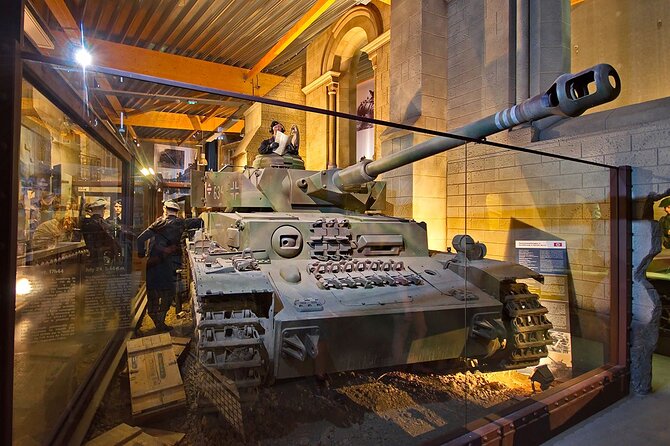
Then you get an included break from outdoor walking, with about an hour at the Overlord Museum. This museum focuses on the stretch from the Allied landing through the liberation of Paris.
What I like about this museum stop is the way it supports the outdoor scenes. The collections include personal items from individual soldiers and reconstructed settings that show armored fighting vehicles from the six armies involved in Normandy. You are looking at roughly 35 vehicles, tanks, and guns across reconstructions, so you can connect what you saw at the beaches to the equipment used in the fight.
This is also where a good guide becomes gold. The best moments here are the ones where the guide helps you understand how the museum items link to the tactical story you heard on the cliffs and at Omaha.
If you have ever felt museums are either too abstract or too detailed, this one hits a useful middle. It is still intense, but it is grounded in real items and visuals.
The American Cemetery at Colleville-sur-Mer: order, names, and quiet impact
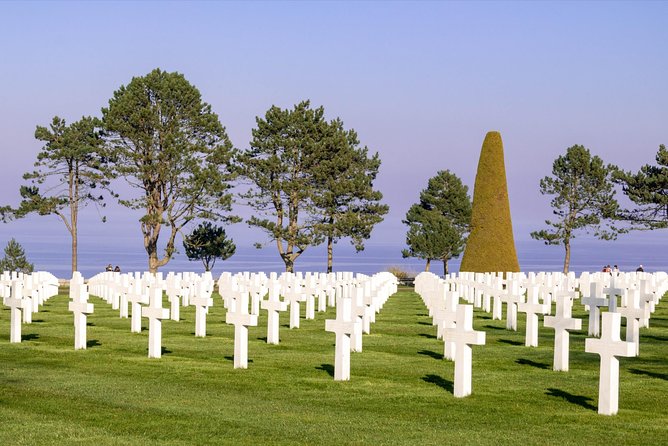
The American Cemetery in Colleville-sur-Mer is a whole different kind of stop. It is beautifully maintained, and it overlooks Omaha Beach nearby, which makes the distance feel real.
The cemetery covers 180 acres and holds 9,387 perfectly aligned white crosses. There is also a memorial chapel that finishes the experience with a reflective mood.
This is where your guide’s storytelling matters most. While walking row upon row of headstones, you hear stories of soldiers who fought nearby and were awarded for gallantry. Then the attention turns to the Walls of the Missing, a semicircular garden listing 1,557 names, with rosettes marking those recovered and identified.
At the center there is the bronze statue titled Spirit of American Youth Rising from the Waves. You also have an orientation table overlooking the beach that helps connect the cemetery view to the landing sites.
This stop is about 1 hour. I recommend slowing down here, even if the day feels heavy. If you rush, it is easy to miss the calm precision of the place, and that calm is part of the message.
Arromanches and the Mulberry harbour remains: the landing’s supply system
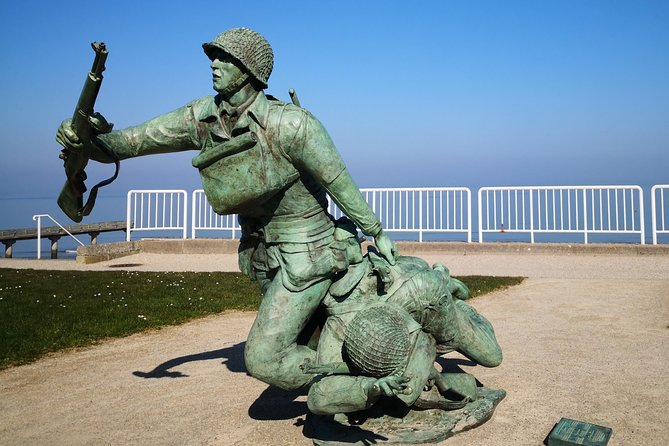
Before you head back toward Paris, you stop at Vestiges du Port de Mulberry in Arromanches. This is where the Allies solved a brutal practical problem: getting supplies and heavy equipment ashore fast, before deep-water ports could be captured.
Arromanches is remembered as one of the Mulberry harbour sites. The artificial port enabled the disembarkation of about 9,000 tons of material per day. The port was commissioned on June 14, 1944.
The explanation here is clear and grounded. Two sites were chosen for the port facilities, with the other built further west at Omaha Beach. The British used floating concrete caissons, towed from England and then assembled into walls and piers with pontoons linked by floating roadways.
Even today, sections of the Mulberry harbour still remain, with huge concrete blocks sitting on the sand, and more visible offshore. This stop is only about 20 minutes, but it gives the day a practical counterweight. You see the battlefield, then you also understand the logistics that helped the landing keep going.
Price and value: what you get for $326.53 per person
At $326.53 per person, this is not a cheap add-on. But it can still feel fair when you break it down.
You are paying for three things that add real value:
- A long day with a private, climate-controlled vehicle and a driver-guide who keeps the schedule tight
- Admission to the Overlord Museum (and the tour materials also mention Caen Memorial Museum admission)
- A max-small group size (7 people), which is often the difference between hearing the guide and just overhearing him
Also, many of the outdoor stops have free admission. That means more of your money goes toward guided time and transportation, not entrance fees stacked stop after stop.
The main cost downside is your time. You will spend most of the day in transit and walking, so you want to be mentally ready for a full commitment. If you only want a quick look, you might feel the hours are too many for the payoff.
Who should book this tour, and who might not love it
This tour fits best if you want structure. You like having a plan, and you like knowing what you are looking at when the place is emotionally intense and historically complex.
It is especially good for:
- Couples and families who want a guided day without managing logistics
- People who care about D-Day details, units, and specific locations along the coastline
- Anyone who prefers a smaller group over coach crowding
It might feel like too much if:
- You want a relaxed, slow sightseeing day
- You hate early mornings and long days of standing and walking
- You are not ready for a moving cemetery visit, even if it is well cared for and respectful
One practical note from experience on this route: bring layers. It can be freezing and rainy, and the day is outdoors for multiple stops. A rain jacket can save your mood.
Quick practical tips to make the day better
- Start with layers and waterproof outerwear. The weather can change fast on the coast.
- Wear comfortable shoes you trust on uneven ground and steps around cliff viewpoints and memorials.
- Bring water and snacks. Lunch and drinks are not included, and the day is long.
- If you want the beach sand souvenir, bring a small container, or be ready to use what the guide offers.
- Plan for a calm pace at the cemetery. Give yourself time to look and absorb, not just photograph.
Should you book this tour?
If your priority is D-Day and you want more than a drive-by, this is a strong choice. The small group size, the structured timing across Pointe du Hoc, Omaha Beach, the American Cemetery, and the Overlord Museum, plus the guide quality highlighted by Regis, are the ingredients that make the day feel coherent.
Book it if you can handle an early start and a long, emotional day. Skip it if you only want a brief taste or you dislike long drives from Paris.
FAQ
How long is the Paris to Normandy day trip?
The duration is about 13 to 14 hours.
What time does the tour start in Paris?
The start time is 6:30am.
How many people are in the group?
The tour has a maximum of 7 travelers.
What are the main stops on the tour?
You visit Pointe du Hoc, the National Guard Monument, Omaha Beach with multiple photo stops and memorials, the Overlord Museum, the American Cemetery at Colleville-sur-Mer, and the Vestiges du Port de Mulberry at Arromanches.
Is museum admission included?
Admission to the Overlord Museum is included. Other stops listed have free admission.
Is lunch included in the price?
Lunch and food and drinks are not included.
What language is the tour offered in?
The tour is offered in English.
Where does the tour meet, and when does it end?
It starts at Théâtre du Lido, 116 bis Av. des Champs-Élysées, 75008 Paris, and it ends back at the meeting point.
What happens if the weather is poor?
This experience requires good weather. If it is canceled due to poor weather, you are offered a different date or a full refund. You can also cancel up to 24 hours in advance for a full refund.
Newest write-ups from Paris






D-Day Landing Beach Day Trips, compared.

Normandy D-Day Sites & Cemetery Day Trip from Paris with Lunch
Read our review →
Normandy D-Day Small-Group Day Trip with Omaha Beach, Cemetery & Cider Tasting
Read our review →
Normandy D-Day Beaches and American Cemetery Day Trip from Paris
Read our review →
Normandy D-Day Sites Guided Day Trip with Lunch
Read our review →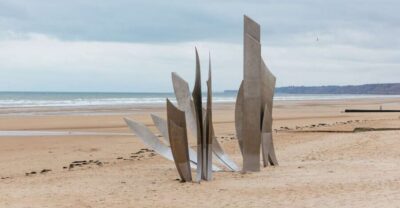
Normandy D-Day Beaches with Juno Beach, bunkers & Canadian Cemetery from Paris
Read our review →
Normandy D-Day Landing Beaches Small-Group Day Trip from Paris
Read our review →
Normandy 2Days Trip Landing Beaches and Mont St Michel from Paris
Read our review →Browse the lists this tour appears in