Reviewed · 1-DAY TOURS
WW1 Australians in the Somme -Villers Bretonneux, Le Hamel – Day trip from Paris
A Somme day trip hits different when it stays personal. This small-group drive from Paris focuses on the Australian story in WWI, with guided stops you can feel in your chest, not just read about. I like that you leave the navigation and timing to the driver guide, so you spend your energy on the places themselves.
What I really like is the seven-person limit. It keeps the commentary from turning into a lecture, and it makes it easier to ask questions as you move between memorials, preserved trenches, and battle landmarks. Another highlight is how the itinerary mixes the big set-piece memorials with smaller sites, so you get both overview and detail.
The main drawback to plan for is the start time. You’re looking at an early morning departure, and it’s a long day outside and on the road, with lunch on your own.
In This Review
- Key highlights at a glance
- Why this Somme route feels more targeted than a generic day trip
- Paris pickup, timing, and what a full day really means (6:30 am to the evening)
- Stop 1: Villers-Bretonneux Australian National Memorial (names, no known graves, and the tower)
- Stop 2: Le Hamel Australian Corps Memorial (why July 4, 1918 mattered)
- Stop 3: Lochnagar Crater (the mine, the moment it went off, and the scale)
- Stop 4: Windmill Memorial at Pozières (Charles Bean’s “soil” moment)
- Stop 5: Mont Saint-Quentin and the Second Australian Division memorial (artwork that tells a story)
- Stop 6: Historial de la Grande Guerre in Peronne (uniforms, trench artists, and Otto Dix)
- Price and value: what $300.06 per person buys you (and what it doesn’t)
- Who should book this Somme day trip
- Should you book it or look for another option?
- FAQ
- What time does the tour start and how long is it?
- Where do I meet the group in Paris?
- How many people are in the group?
- What language is the tour offered in?
- Is lunch included?
- Is admission to the museum included?
- Do I need a paper ticket?
- What happens if the tour is canceled due to poor weather?
Key highlights at a glance
- Seven people max, so the day feels human, not rushed
- Australian-focused sites, including Villers-Bretonneux and Le Hamel
- Trench and crater memorials like Lochnagar, where the scale becomes real
- Le Hamel’s modern warfare angle, infantry, artillery, air, and tanks together
- Historial de la Grande Guerre access, plus works by trench artists like Otto Dix
A handful more Paris options to weigh up
- Disneyland® Paris 1-Day Ticket
★ 4.6 · 49,412 reviews - Normandy D-Day Sites & Cemetery Day Trip from Paris with Lunch
★ 5.0 · 6,877 reviews - Day Trip to Mont-Saint-Michel from Paris
★ 4.5 · 4,876 reviews - Disneyland® Paris 1-Day Flexible Date Ticket
★ 4.3 · 4,347 reviews
Why this Somme route feels more targeted than a generic day trip
Paris to the Somme is a long haul, so you want the route to make sense. This one is built around a clear theme: Australians in the Somme, told through places that connect directly to actions on the Western Front. Instead of trying to cover everything, the day goes for depth, at multiple stops, on purpose.
The small-group setup matters more than people think. Big tours can feel like a slideshow, with you jogging between photos. Here, the pacing is designed so you can actually read inscriptions, notice what’s preserved, and understand why each stop is placed where it is. That is where the emotional impact comes from, not the number of sites.
Also, the guide is driving and talking at the same time, so logistics stay simple. You get vehicle transport with air-conditioning, and you’re not stuck trying to figure out where to park or which road takes you to the next memorial.
Paris pickup, timing, and what a full day really means (6:30 am to the evening)
This tour starts at 6:30 am from the Théâtre du Lido on the Champs-Élysées area (116 bis Av. des Champs-Élysées, 75008 Paris). The day runs about 12 to 13 hours, and the meeting point is the same at the end.
Two practical notes for planning:
- Hotel pickup is not included, so you’ll want to build time to reach the meeting point early.
- Lunch isn’t included, so you should bring snacks or plan to buy something near the scheduled lunch window.
Because the route is in memorial parks and historical grounds, you should expect some walking and standing. Wear comfortable shoes, especially if weather is damp. The itinerary also depends on good weather, so you may want to avoid locking your entire Paris schedule too tightly on that one day.
Stop 1: Villers-Bretonneux Australian National Memorial (names, no known graves, and the tower)
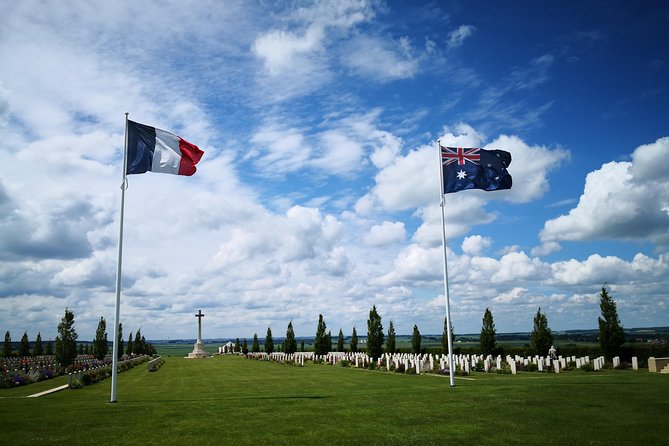
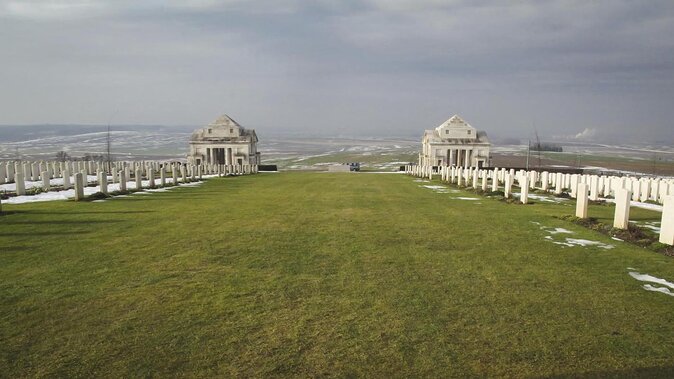
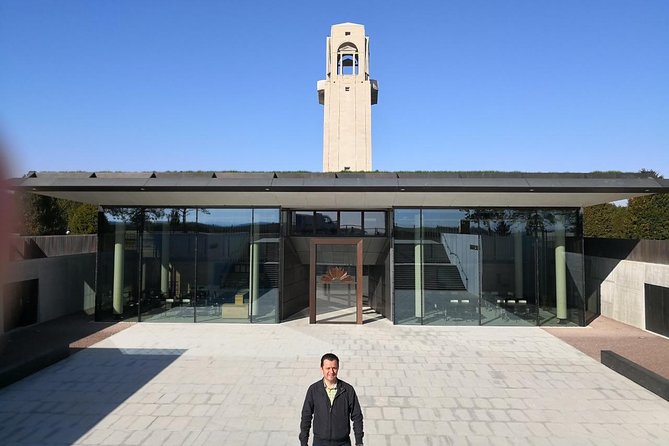
Your first stop is the Australian National Memorial at Villers-Bretonneux, the main memorial for Australian servicemen killed on the Western Front with no known grave. It lists 10,773 names of soldiers of the Australian Imperial Force who were killed between the time Australians arrived in France and Belgium in 1916, and the end of the war.
This memorial is not random. The location was chosen to commemorate Australia’s role in the Second Battle of Villers-Bretonneux (24 to 27 April 1918), when the area mattered both militarily and symbolically. It is built to make you slow down and read. And once you do, the names stop feeling like text and start feeling like individuals.
What to look for here:
- The memorial’s central feature is a tower in the grounds of the Villers-Bretonneux Military Cemetery, with the Cross of Sacrifice nearby.
- Names of the missing are carved or listed on panels around the tower, and you’ll see inscriptions in both French and English.
The design connects architecture and remembrance in a way that’s easy to understand. This is also maintained by the Commonwealth War Graves Commission, which is part of why it feels cared for, not abandoned or neglected. Plan on about 40 minutes for this stop.
Stop 2: Le Hamel Australian Corps Memorial (why July 4, 1918 mattered)
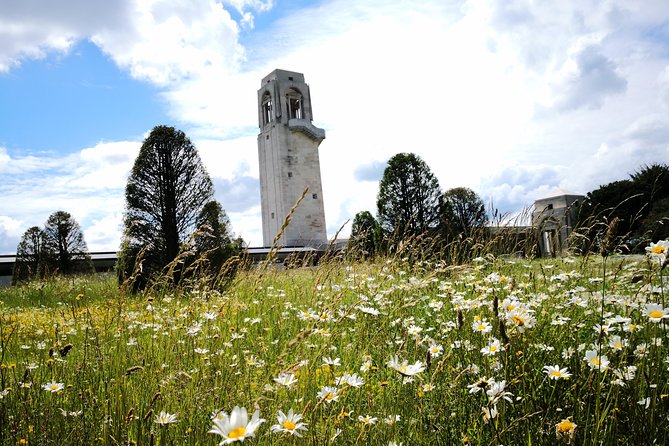
Le Hamel gives you a different angle on WWI. Instead of focusing only on the earlier trench stalemate, it points to a battle that helped push warfare into a more coordinated, modern direction.
This memorial park commemorates and interprets the battle of Le Hamel on 4 July 1918. It highlights a breakthrough approach backed by the Americans: General Monash’s plan combined infantry, artillery, air forces, and tanks together in a single operation. The idea was to support the attack in a way that broke through more effectively than older methods.
The park includes panoramic displays and explanatory panels that help you grasp the strategic challenge the terrain created. Several trenches have been preserved, so it’s not only about reading plaques.
What I like about this stop is that it explains the battle as a system. It’s easy to think WWI is only mud and misery. Le Hamel shows the evolution of tactics, without turning the topic into a textbook.
You’ll have about 30 minutes, and admission is free.
If this one is booked out, Paris has these too:
- Paris: 1-Hour Seine Cruise departing from the Eiffel Tower★ 4.4 · 77,472 reviews
- Paris: Versailles Palace and Gardens Full Access Ticket★ 4.6 · 41,579 reviews
- Paris: Arc de Triomphe Rooftop Tickets★ 4.6 · 34,264 reviews
- Paris: Orsay Museum Entry Ticket★ 4.7 · 25,647 reviews
Stop 3: Lochnagar Crater (the mine, the moment it went off, and the scale)
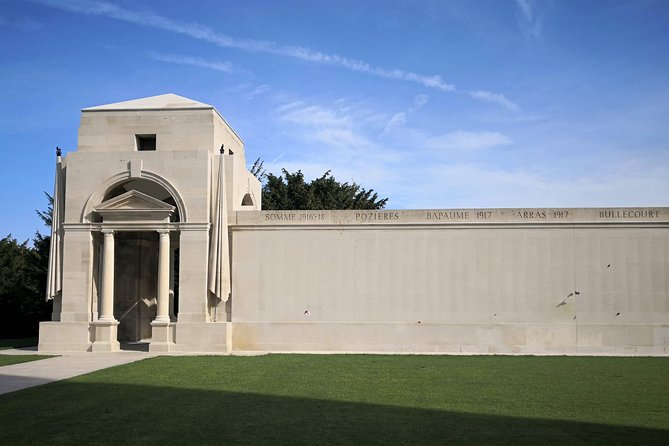
Lochnagar Crater is short on time, but powerful. The mine south of La Boisselle, in the Somme region, was a secretly planted underground explosive charge prepared for 1 July 1916, the first day of the Somme.
This site is tied to the Tunnelling Companies of the Royal Engineers and a German field fortification called Schwabenhöhe. The British named the mine after Lochnagar Street, the trench from which the gallery was driven.
If you want one detail that makes the crater feel real, it’s the size:
- The mine was sprung at 7:28 a.m. on 1 July 1916.
- It left a crater about 30 meters deep and 100 meters wide.
You’ll learn how it fit into the larger plan, including that there were 19 mines placed beneath German lines along the British part of the front. Most craters are photographed from a distance. Here, the stop is designed to help you stand near it and understand what that sudden blast meant for troops on the ground.
The crater is preserved as a memorial, and a religious service is held each 1 July. Plan around 10 minutes.
Stop 4: Windmill Memorial at Pozières (Charles Bean’s “soil” moment)

At Pozières, the Windmill site turns tragedy into geography. It was established as an Australian memorial in the 1930s after Australia’s official war historian, Charles Bean, suggested the place be marked because the ridge was more densely soaked with Australian sacrifice than anywhere else.
The key numbers to understand:
- Over seven weeks in 1916 at the Battle of the Somme, the Australian Imperial Force suffered 23,000 casualties.
- More than 6,700 died in the countryside around the Windmill.
There’s also a meaningful connection across countries. On 11 November 1993, soil from the Windmill site was cast over the coffin of Australia’s Unknown Soldier during his funeral at the Australian War Memorial in Canberra. That detail matters, because it shows remembrance didn’t stop in France, and it didn’t stay in the past.
This stop is about 10 minutes, and it’s free to enter. It’s the kind of brief stop that sticks with you, because it compresses a huge amount of loss into one place you can actually point to.
Stop 5: Mont Saint-Quentin and the Second Australian Division memorial (artwork that tells a story)
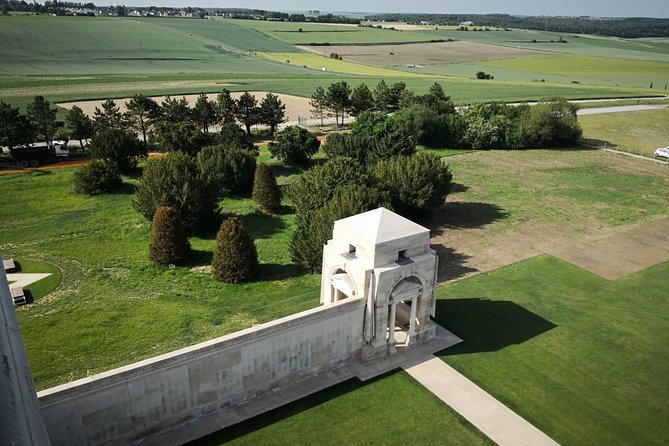
Next is the 2nd Australian Division Memorial, part of the Mont Saint-Quentin area. It’s on the road from Bapaume to Péronne, and it has a history that feels both fragile and stubborn.
A few details make it more than a monument:
- It was the only one of five division memorials initiated by members of the division.
- The base was erected in 1925.
- It includes bronze bas-reliefs by May Butler-George, showing men hauling and pushing a gun, and men advancing with bayoneted rifles and hand-grenades.
- At the top is an Australian soldier thrusting his bayonet through a German eagle.
- The sculptor was Charles Web Gilbert.
Then came the destruction. In 1940, German soldiers smashed the memorial. A replacement statue by Stanley Hammond of a thoughtful Australian soldier looking down was erected in 1971.
Why this stop is worth your attention: it explains how memory survives through damage, rebuilding, and the choices people make decades later. You get art, propaganda-era symbolism, and postwar recovery, all in one small area. Plan around 10 minutes, and it’s free.
Stop 6: Historial de la Grande Guerre in Peronne (uniforms, trench artists, and Otto Dix)
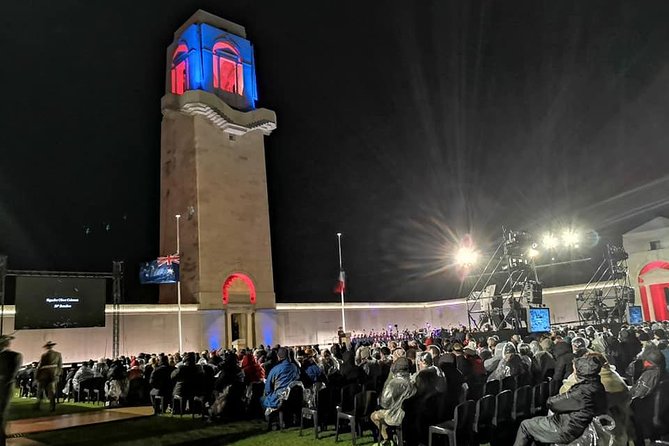
After lunch, the day ends at the Historial de la Grande Guerre in Péronne. Admission is included, and you get about 1 hour to explore.
The museum is housed in a 13th-century medieval castle. That building matters, because it anchors the story in a real place, not only in battlefield open air. Inside, you’ll find exhibits of uniforms and weapons actually worn and used during the conflict. That kind of hands-on material helps you picture what soldiers did day after day.
One section I’d make time for is the permanent collection of Trench Artists, including artists such as Otto Dix. Trench art here is presented as testimony, sketching atrocities with graphic etchings. Even if you think museums are “too much text,” this portion can feel different because it uses visual testimony instead.
This is also a good way to process the emotional weight of the outdoor stops. The day is intense. The museum gives you context, and it explains how people tried to make sense of what they survived.
Price and value: what $300.06 per person buys you (and what it doesn’t)
At $300.06 per person, this is not a budget day trip. But for Paris, the price can make sense because you’re buying four things together:
- Transport in an air-conditioned vehicle
- A driver guide who handles the route
- Admission included to the Historial de la Grande Guerre
- A small group size capped at seven, which reduces time-wasting and keeps the story coherent
What you’re not getting is part of the calculation. Lunch is not included, and there’s no hotel pickup. That means you’ll likely spend extra on food, and you’ll need to be ready to get yourself to the meeting point at 6:30 am.
When this tour is worth it:
- You want a focused route with Australian WWI sites as the backbone.
- You prefer guidance over self-driving, especially on a long day.
- You care about the details, not just the postcard versions.
When it might not fit:
- If you’re only interested in one or two iconic stops, you may prefer a shorter or cheaper option.
- If early mornings wreck you, plan for that reality.
Who should book this Somme day trip
This tour is a great match for people who:
- Want an Australian-centered explanation of the Western Front, not a generic overview
- Like small-group travel and clear pacing
- Are curious about how WWI changed over time, including tactical shifts highlighted at Le Hamel
- Appreciate museums with specific themes, especially trench art and period artifacts
It can also work well for teens, as long as they’re open to the subject. The sites are intense, but the variety from memorials to crater to museum can keep the day from feeling repetitive.
Should you book it or look for another option?
I think you should book this if you want your Somme day to be more than a checkbox. The structure is strong: major memorials with real inscriptions, battle-ground sites that show scale, and a museum finish where you can process the whole story with artifacts and trench art like Otto Dix.
Skip it and shop around if you need a relaxed pace, or if the idea of an early departure and long hours outside sounds like a headache. Also, since you’re responsible for lunch, build that into your day.
If you can handle a full day and you’re drawn to Australian WWI history, this one is a smart use of time. You’ll come away with names, places, and context that fit together.
FAQ
What time does the tour start and how long is it?
The tour starts at 6:30 am and runs about 12 to 13 hours.
Where do I meet the group in Paris?
You meet at Théâtre du Lido, 116 bis Av. des Champs-Élysées, 75008 Paris. The tour ends at the same place.
How many people are in the group?
This experience has a maximum of seven travelers.
What language is the tour offered in?
The tour is offered in English.
Is lunch included?
No. Lunch is not included.
Is admission to the museum included?
Yes. Admission to the Historial de la Grande Guerre in Péronne is included.
Do I need a paper ticket?
No. You receive a mobile ticket.
What happens if the tour is canceled due to poor weather?
If it’s canceled due to poor weather, you will be offered a different date or a full refund.
Newest write-ups from Paris





1-Day Tours, compared.


Normandy D-Day Sites & Cemetery Day Trip from Paris with Lunch
Read our review →

Disneyland® Paris 1-Day Flexible Date Ticket
Read our review →
Loire Valley Castles Day Trip from Paris with Complementary Wine
Read our review →
Giverny, Monet’s Home & Gardens Half-Day Trip
Read our review →
Normandy D-Day Small-Group Day Trip with Omaha Beach, Cemetery & Cider Tasting
Read our review →