Reviewed · PRIVATE
WW1 Somme Battlefields – Private tour from Paris aboard a Van (2 pax)
A Somme day starts early, then hits hard. I like the private door-to-door van and Regis, the guide who connects the big picture to what you are actually looking at. I also love that the route mixes craters, trench scars, memorials, and museums so the story lands on more than one level. The only real catch is the packed schedule, with some stops kept short, so you will want comfortable shoes and patience for a long day.
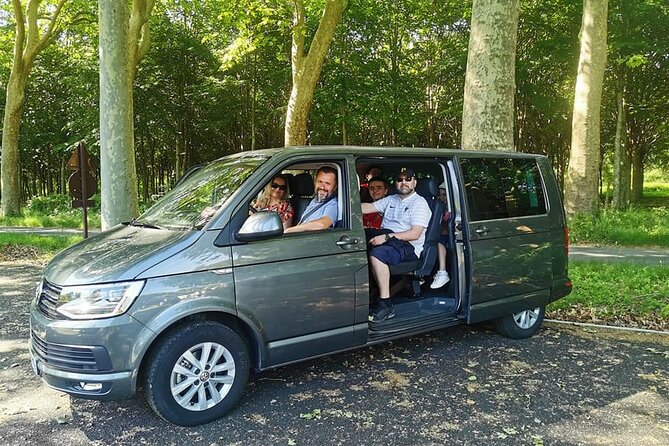
This is a true small-group format, just your party in an air-conditioned vehicle, picked up in select Paris neighborhoods and driven round-trip from the city. Start time is 6:30 am, and you are back late in the evening, but the payoff is that you do not spend hours figuring out trains, timing, or transfers on your own.
In This Review
- Key things you will notice on this Somme day
- Why a Paris-to-Somme private van is worth it
- The 6:30 am start and how to survive a long WWI day
- Stop 1: Lochnagar Crater near La Boisselle
- Stop 2: Ulster Memorial Tower and Thiepval Wood
- Stop 3: Historial de la Grande Guerre in Thiepval (mural and trench artifacts)
- Stop 4: Beaumont-Hamel Newfoundland Memorial and preserved trenches
- Stop 5: Delville Wood War Memorial in Longueval
- Stop 6: The Historial de la Grande Guerre in Péronne, uniforms, weapons, and trench artists
- Price and value for a 2-person private day from Paris
- Who should book this Somme tour
- Should you book this Somme private tour from Paris?
- FAQ
- What time does the Somme tour start from Paris?
- How long is the day trip to the WW1 Somme battlefields?
- Where in Paris do you offer pickup and drop-off?
- Is this tour private, and how many people can go?
- What language will the tour be in?
- Are museum admissions included?
- Is lunch included?
- What is the cancellation and refund window?
Key things you will notice on this Somme day
- Lochnagar Crater’s mine story is shockingly specific, with details about the July 1, 1916 opening and the Schwaben Höhe target
- Ulster Memorial Tower and Thiepval Wood are positioned for seeing how front lines and objectives sat across from each other
- The Historial de la Grande Guerre in Thiepval uses a huge mural and a panoramic battlefield presentation to make sense of the hours of fighting
- Beaumont-Hamel’s preserved trenches let you walk where parts of the Newfoundland advance failed, with the ground still showing scars
- Delville Wood’s South African Memorial adds a key Commonwealth layer you might miss on a quick day trip
- The Historial in Péronne (in a medieval castle) grounds everything with uniforms, weapons, and trench artist testimony
A handful more Paris options to weigh up
- Louvre Museum Paris Essential Guided Tour Semi-Private 6ppl Max
★ 5.0 · 3,807 reviews - SUV Private Transfer: Paris to Charles de Gaulle Airport (CDG)
★ 4.0 · 3,091 reviews - Paris: Private Photoshoot at the Eiffel Tower
★ 4.7 · 2,636 reviews - Top Private Cruises in Paris with French Champagne and surprises
★ 5.0 · 1,553 reviews
Why a Paris-to-Somme private van is worth it
WWI battlefield days sound simple on paper. In real life, it is the logistics that can drain you: long drives, early starts, and timed museum access. A private van solves the annoying bits. You leave Paris at 6:30 am, ride comfortably in an air-conditioned vehicle, and come back the same day without juggling public transport.
What I like most is the guide’s role. You are not just driving from one plaque to another. Regis explains the context, then points you toward what to notice on site, like how Lochnagar connects to the German strongpoint, or why Thiepval mattered as an Allied objective that took months to secure.
For value, think of what you get bundled into one day: transportation, guided commentary, and museum time. Even if you plan to see “just the highlights,” you usually end up paying for entry fees and losing time to travel. Here, the schedule is built to keep you moving, but with enough stops that you still absorb the meaning.
The 6:30 am start and how to survive a long WWI day
This tour is timed for distance. You start at 6:30 am, then spend about 12 to 13 hours on the move, including multiple stops. That early start is not for everyone, but it does buy you something: daylight and less rush at each site.
Practical tip: plan for a long sit in the van. Bring water, and wear layers. The battlefield air can feel colder and windier than central Paris, especially when you are outside near preserved trenches or memorials.
Also note: lunch is not included. You will want to eat either before pickup or bring a plan for midday. In a day like this, food breaks are small but important, and the lack of a provided lunch means you should decide what you will do in advance.
Stop 1: Lochnagar Crater near La Boisselle
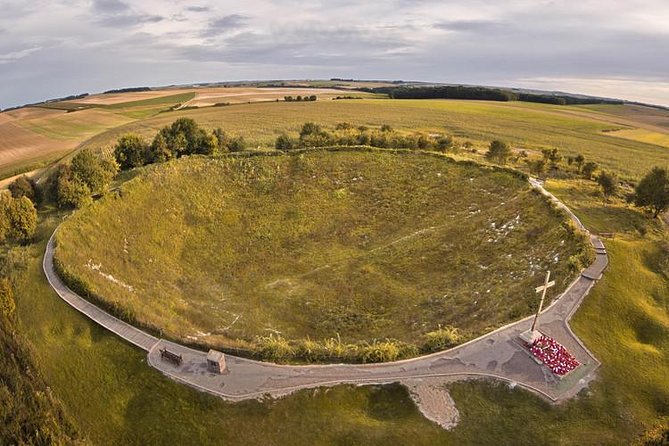
Lochnagar Crater is the kind of site that makes your brain go quiet. The ground is not just “historic,” it is a physical result of industrial-scale warfare.
What makes this stop special is the level of detail you get. The crater was created by a large mine placed beneath the German front lines on the first day of the Battle of the Somme, July 1, 1916. The British even named the mine after Lochnagar Street, a British trench from which tunnelling companies dug down about 90 feet into the chalk. Then they excavated roughly 300 yards toward the German lines to plant about 60,000 lbs (27 tons) of ammonal explosive in two underground chambers.
The aim matters too. This mine was designed to destroy a fortified strongpoint called Schwaben Höhe, south of the village of La Boisselle. It is a powerful reminder that the first day of the Somme was not only infantry charge and artillery smoke. It was also engineering, planning, and the hope that a single moment could change everything.
A consideration: the time here is listed as about 10 minutes. That is enough to see the crater and hear the story, but if you want slow, contemplative pacing, you will need to keep expectations in check. Think of Lochnagar as a sharp opener, not a long stop.
Stop 2: Ulster Memorial Tower and Thiepval Wood
After Lochnagar, you shift from an explosive impact site to a front-line view with meaning.
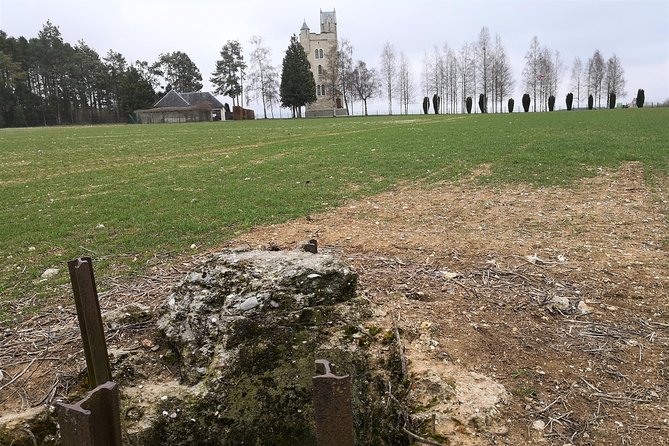
The Ulster Memorial Tower stands on ground that was on the German front line from July to November 1916. It was erected on the site of the Schwaben Redoubt, a strongly fortified position that the Ulster Division eventually captured. This is one of those places where the location is the history: you are standing where the Germans built strength, and where a specific unit fought for objectives in that sector.
Your guide also connects the tower to Thiepval Wood, which sits opposite. The 36th (Ulster) Division made its historic charge here on July 1, 1916, a charge tied to the start of the Somme. Even if you know the date, it helps to get oriented in the geography, because the memorial layout makes you visualize distance and direction.
This stop is scheduled for about 30 minutes. You get enough time for the big landmarks and the key interpretation, without feeling rushed through everything.
If this one is booked out, Paris has these too:
- Paris: 1-Hour Seine Cruise departing from the Eiffel Tower★ 4.4 · 77,472 reviews
- Disneyland® Paris 1-Day Ticket★ 4.6 · 49,412 reviews
- Paris: Versailles Palace and Gardens Full Access Ticket★ 4.6 · 41,579 reviews
- Paris: Arc de Triomphe Rooftop Tickets★ 4.6 · 34,264 reviews
Stop 3: Historial de la Grande Guerre in Thiepval (mural and trench artifacts)
Now the day shifts from outdoor ground to how the war was remembered and explained.
At the Historial de la Grande Guerre in Thiepval, you start with a large animated map, supported by period photos and film, which sets the impact of the Somme battles in context. Then comes a visual centerpiece: a panoramic mural by illustrator Joe Sacco, telling the story of 1 July 1916 hour after hour. The mural is reproduced across 60 metres of back-lit glass, so you are not looking at one scene. You are following operations across time.
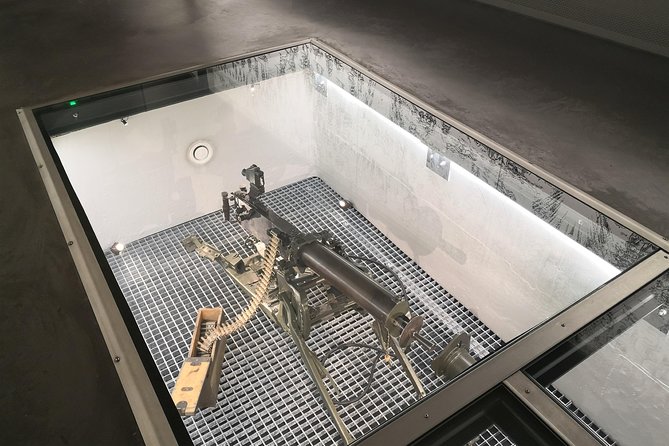
One of the most striking elements is the glass-covered display pit in the hall. It shows collection pieces and archaeological remains, with short videos that add commentary and historical detail to scenes from the mural. It is a good way to connect what you see outdoors to what the museum recovered and studied.
You also encounter a Maxim machine gun captured by a British regiment at Thiepval. That detail is important because it underscores how heavily the Germans defended this location. Thiepval ridge was an Allied objective on July 1, but it was not taken until the end of September. The museum does not let you treat July 1 as a single clean moment.
This stop runs about 30 minutes and is scheduled with admission included. With that time, you get a strong orientation and a sense of scale, without turning the museum portion into a half-day ordeal.
Stop 4: Beaumont-Hamel Newfoundland Memorial and preserved trenches
This is the emotional anchor of the tour for many people, and I get why.
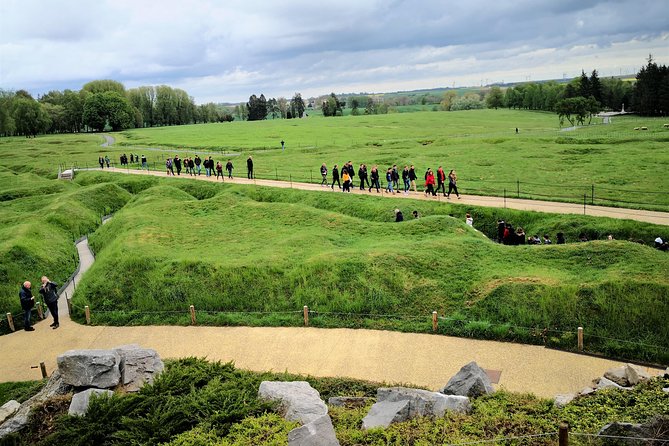
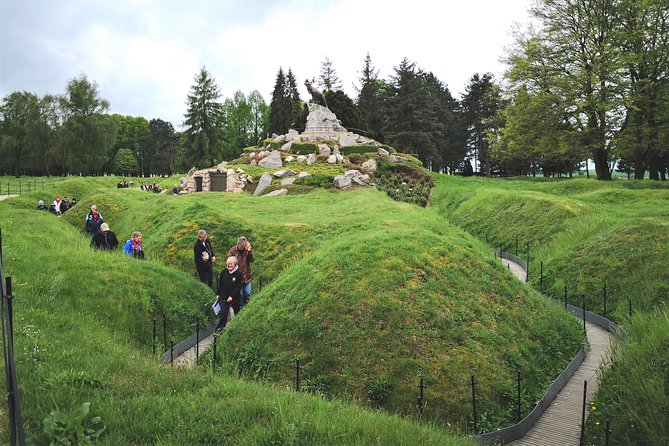
The Newfoundland Memorial Park at Beaumont-Hamel preserves a large portion of the battleground. You walk through a network of now-serene original trenches, yet you still see the scars of the battle on the ground. It is one thing to read casualty figures, and another to stand in the preserved terrain that shaped the outcome.
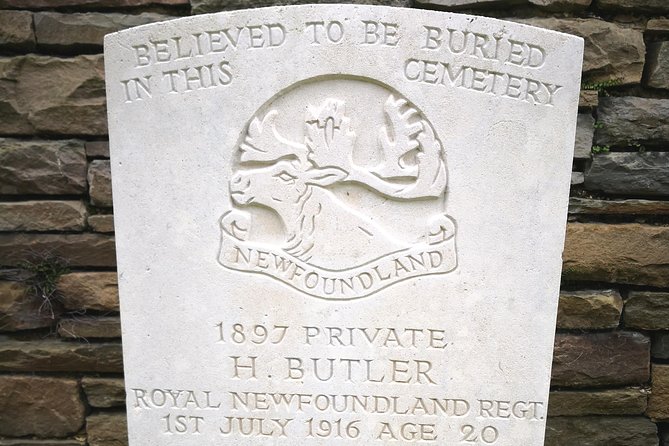
The memorial is dedicated to the Dominion of Newfoundland forces killed in WWI. The park covers the grounds over which the Newfoundland Regiment launched an unsuccessful attack on July 1, 1916. On that morning at 8:45 am, the Newfoundland Regiment and the 1st Battalion of the Essex Regiment received orders to move forward. Of the 780 men who went forward, only about 110 survived unscathed, and only 68 were available for roll call the next day.
If that sounds blunt, good. It is supposed to be. The point is not to overwhelm you, but to make the memorial more than a name list. You start understanding what it meant for small units to cross ground under fire, and why preserved trenches matter for comprehension.
Time here is about 1 hour, with free admission. This longer stop helps you slow down after the heavier interpretation at Thiepval.
Stop 5: Delville Wood War Memorial in Longueval
Delville Wood adds a South African layer that rounds out the Somme story.
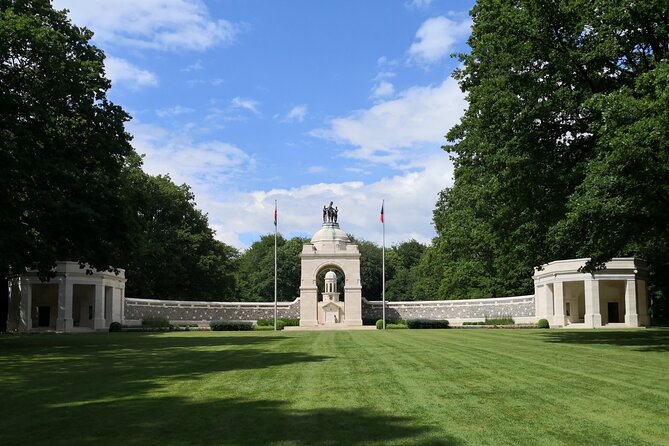
The South African Memorial marks the role played by South African forces in the Battle of Delville Wood, part of the Somme Offensive. It is tied to the first action seen by South Africa in Flanders and France. If your Somme knowledge is mostly British and French, this memorial helps you widen the cast of the war.
The memorial’s design details are also worth noticing. It was designed by Sir Herbert Baker, with assistant architect Arthur James Scott Hutton and sculpture by Alfred Turner. The flint and stone screen on either side of an archway includes shelters at each end. On top sits Turner’s bronze statue of two men and a war horse, symbolizing Castor and Pollux and representing two white races of South Africa.
Even if you do not read every sculptural symbol, the memorial gives you something practical. It reminds you that “Somme” is not one nation’s story. It was a multinational fight, and the commemorations reflect that.
This stop is scheduled at about 40 minutes, with free admission.
Stop 6: The Historial de la Grande Guerre in Péronne, uniforms, weapons, and trench artists
After lunch (not included), the day ends in a museum that helps you take the whole experience home in your head.
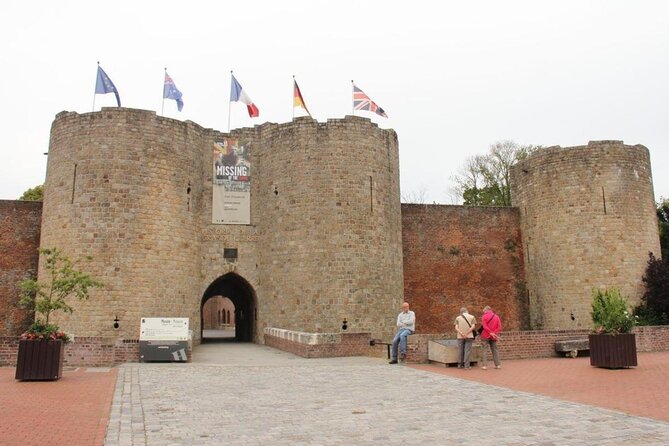
The Historial in Péronne is housed in a 13th-century medieval castle. The setting matters because it turns WWI into something housed and studied, not only remembered in open air. Inside, you see uniforms and weapons worn and used by soldiers, plus exhibits built around daily life at the front for different nationalities.
One part I found especially useful for making sense of what you have already seen is how the museum structures the galleries. It focuses on life at the front and the broader cultural and social scale of the war, not just battlefield tactics. You also find soldiers represented by mannequins dressed in uniforms, with weapons and personal effects nearby.
The museum also includes trench artists, including Otto Dix, and you see how artistic testimony recorded the atrocities of war with graphic etchings. That matters after visiting memorials and preserved trenches, because it gives you another way to process the same reality, through testimony rather than only battlefield geography.
There is also a strong emphasis on civilians, with wall cabinets divided by Germany, France, and Great Britain to show how war mobilized everyday life.
This museum time is scheduled for about 1 hour, and the tour description lists admission included.
Price and value for a 2-person private day from Paris
At $976.96 per group (up to 2), you are paying for comfort, time savings, and guided interpretation. This is not the cheapest way to do the Somme. But it often ends up cheaper than buying separate transport tickets plus museum entry plus a guide for only part of the day.
Here is what you really get for the money:
- Round-trip private transportation from Paris, which saves you hours of scheduling stress
- Hotel pickup and drop-off in specific districts (75008, 75007, 75016), so you are not starting your day with a transfer
- A driver guide who can explain how each site fits into the wider battle, so the facts connect instead of piling up
- Museum access time, including the Historial in Péronne
If you are traveling alone, the price can feel steep. If you have one other person, it becomes easier to justify because the van cost is shared.
Who should book this Somme tour
I think it fits best if you:
- Want to see major Somme sites in one day without wrestling with public transit
- Prefer a private pace where you can ask questions and spend a moment longer when something grabs you
- Want both the outdoor memorial experience and the museum interpretation, including the Thiepval and Péronne Historials
It may be less ideal if you:
- Need a slower itinerary with lots of time at fewer sites
- Get worn down by early mornings and long days
- Are relying on lunch being provided, since it is not included
Should you book this Somme private tour from Paris?
If you want a day that actually makes the Somme make sense, I would book it. The combination of guided context, multiple memorials, and two museum stops means you get geography and interpretation, not just photos and names.
Use this as your deciding question: do you want someone to tie Lochnagar, Ulster and Thiepval, Beaumont-Hamel, Delville Wood, and Péronne into one coherent story? If yes, this private van day is a strong choice.
If you tell me your travel dates and which Paris neighborhood you are staying in, I can also help you sanity-check whether the pickup areas match your lodging and what time you should aim to leave for lunch planning.
FAQ
What time does the Somme tour start from Paris?
The tour starts at 6:30 am.
How long is the day trip to the WW1 Somme battlefields?
Plan for about 12 to 13 hours total.
Where in Paris do you offer pickup and drop-off?
Hotel pickup and drop-off are offered only in these districts: 75008, 75007, and 75016.
Is this tour private, and how many people can go?
Yes, it is private. Only your group participates, and the tour is listed for up to 2 people.
What language will the tour be in?
The tour is offered in English.
Are museum admissions included?
Admission to the Historial of the Great War Museum in Péronne is included, and the schedule also includes admission for the Historial stop in Thiepval.
Is lunch included?
No, lunch is not included.
What is the cancellation and refund window?
You can cancel for free up to 24 hours in advance of the experience start time for a full refund.
Newest write-ups from Paris






Private, compared.
Louvre Museum Paris Essential Guided Tour Semi-Private 6ppl Max
Read our review →
SUV Private Transfer: Paris to Charles de Gaulle Airport (CDG)
Read our review →

Top Private Cruises in Paris with French Champagne and surprises
Read our review →
Golf Cart in Paris – Private Guided City Tour – Pickup Included
Read our review →
Private Paris Airport Arrival Transfer – CDG & ORLY Airports
Read our review →
Paris Private Arrival Transfer from Charles de Gaulle (CDG) or Orly (ORY)
Read our review →