
Reviewed · MONTMARTRE HILL TOURS
Paris: Montmartre Must-See Walking Tour with a Local Guide
Paris gets dramatic when you walk uphill. This Montmartre tour is built around stories you can actually see, from the climb toward Sacré-Cœur to the street level art culture that made this hill famous. You start near the Carrousel de Saint-Pierre, then move through gardens, viewpoints, and tiny Paris details most people miss.
I especially like how the guide turns landmarks into living history, with stops tied to art, music, and everyday street life. I also like the rhythm: short photo pauses plus enough time at major spots that you do not feel rushed while the city keeps on moving around you.
One drawback to consider is the physical side. The route includes uphill paths and cobblestones, and it is not suitable for wheelchair users or people with mobility impairments.
In This Review
- Key highlights worth planning around
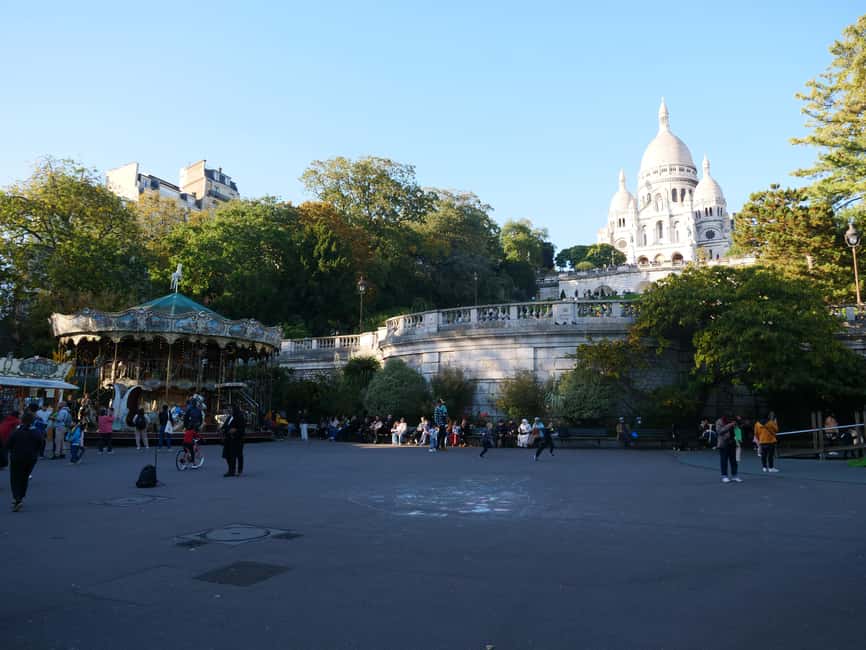
- Starting at Carrousel de Saint-Pierre, where Montmartre begins
- Louise Michel Gardens: a calm warm up before the big climb
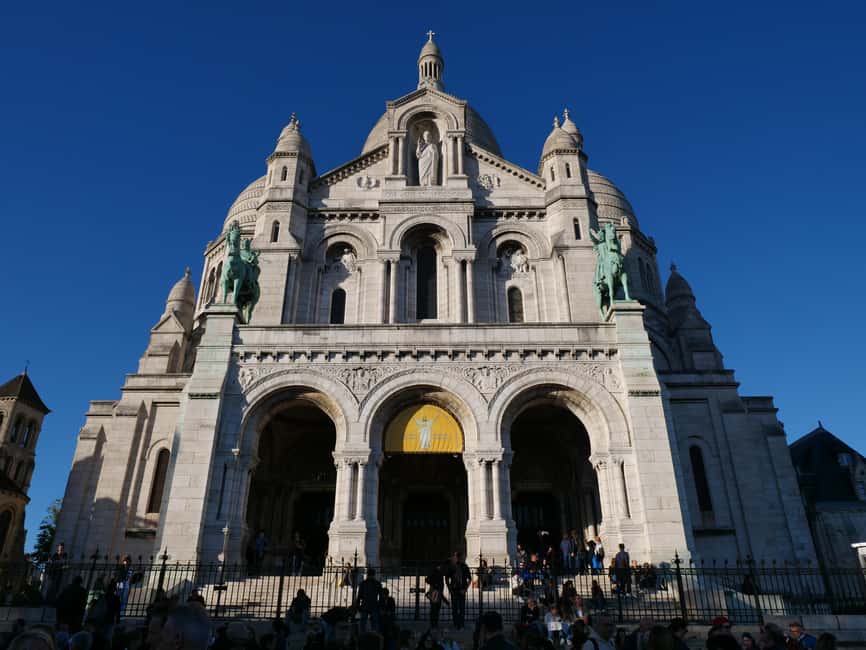
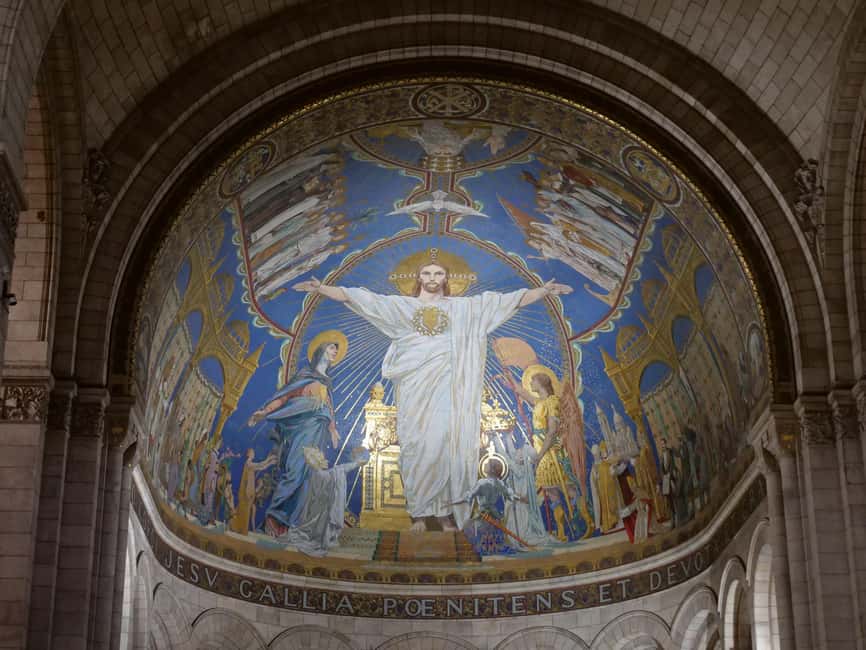
- Sacré-Cœur: mosaics, mosaics, and that Paris view
- Place du Tertre: where artists, painters, and history meet
- Le Poulbot and the street children story you can feel
- Vignes du Clos Montmartre: the city’s hidden vineyard
- La Maison Rose and the pastel-pink Montmartre icon
- The in-between photo stops: small pauses that change your whole route
- Dali Museum and Au Lapin Agile: surreal art and real legend
- Dalida, Place des Abbesses, and the quieter corners that feel local
- Moulin de la Galette: windmill history you can actually picture
- Bateau-Lavoir and the artist workshop legacy
- Le Mur des Je T’aime: the romantic finale that earns its photos
- Price and value: $29 for 150 minutes in the right places
- Getting the meeting right: how to find your guide fast
- Who should book this Montmartre walk, and who should skip it
- Should you book this Montmartre walking tour?
- FAQ
- Where is the meeting point for the Montmartre walking tour?
- What time should I arrive?
- How long is the tour?
- Is the tour offered in English?
- Does the tour run in bad weather?
- Is food included?
- Do I need comfortable shoes?
- Is the tour wheelchair accessible?
- What is the cancellation policy?
Key highlights worth planning around
- Sacré-Cœur mosaics and one of Paris’s best lookouts from the parvis
- Place du Tertre for painters, caricaturists, and classic Montmartre energy
- Vignes du Clos Montmartre, a rare working vineyard inside the city
- Moulin de la Galette and Bateau-Lavoir, where art and bohemia took root
- Le Mur des Je T’aime to end with a romantic, photo friendly finale
- Small group + guide led storytelling, plus audio in English
Other climbs up the Butte:
- Montmartre Hidden Gems and Scenic Highlights Walking Tour
★ 5.0 · 2,684 reviews - Montmartre Hill French Gourmet Food and Wine Tasting Walking Tour
★ 5.0 · 2,588 reviews - Paris: Montmartre Highlights Walking Tour with a Local Guide
★ 4.9 · 2,318 reviews - Paris: Montmartre Cheese, Wine & Pastry Guided Walking Tour
★ 4.8 · 2,255 reviews
Starting at Carrousel de Saint-Pierre, where Montmartre begins
Your tour starts at Place Saint-Pierre in the 18th arrondissement, at the bottom of Square Louise Michel. Look for Café Le Ronsard, the one with the red storefront, then walk up a few steps toward the carousel. Your guide is easy to spot with a French Tales sign and a stick featuring Disney’s Ratatouille character.
This meeting point matters because it gets you out of “transport hub mode” and into “Montmartre mode” right away. The first stretch sets the tone. You are not just moving from one postcard to the next, you are learning how this hill became an artists’ address, then a tourist magnet, then something in between.
I like that the tour includes an English audio guide along with the live English guide. That gives you a backup for details you might miss in a lively street crowd, and it also helps you keep your eyes up while you listen.
Practical tip: wear comfortable shoes. If you think you can “power walk” in sneakers, fine, but plan for cobblestones and some uphill effort.
Louise Michel Gardens: a calm warm up before the big climb
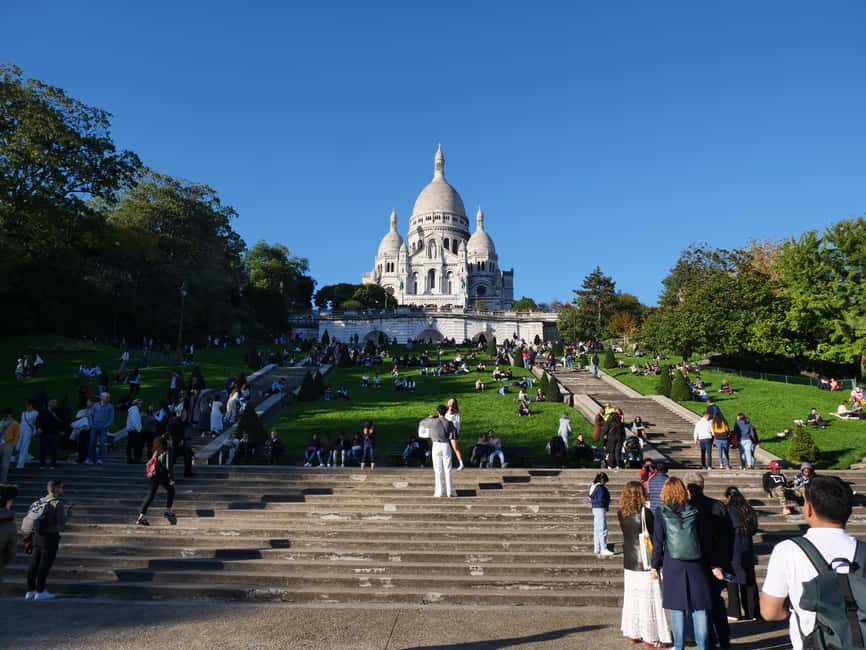
Right after you meet, you get a photo stop at Square Louise Michel. This is a softer start than what most visitors expect on their first Montmartre morning. The gardens give you a breather, and the hilltop views start to make sense.
You are essentially doing orientation without realizing it. Once you understand where the hill rises and where the open squares sit, the rest of your route becomes easier to follow. You can also pace yourself here, which is smart because later you’ll be climbing toward Sacré-Cœur Basilica and walking through tighter streets.
If you are traveling with teenagers or a friend who usually tunes out history tours, this part helps. Gardens and viewpoints feel less like a lecture and more like a “walk and look” experience.
Sacré-Cœur: mosaics, mosaics, and that Paris view
The big anchor stop is Sacré-Cœur Basilica. You start with a photo stop, then you climb to the parvis and step inside.
Outside, the parvis is where you understand why people come here. From one of Paris’s higher points, you get a wide view that makes the city feel connected instead of fragmented. Inside, the focus shifts to the basilica’s mosaics. This is the kind of detail that is hard to appreciate at speed. Having guided time means you can look with purpose, not just look up.
There is also a practical benefit to the way this tour structures it. You get dedicated time at the church area, so you are not competing with the crowd for five seconds of viewing while everyone else is rushing.
Consideration: if you are sensitive to stairs or long uphill stretches, this is the most demanding stop. Plan slow steps, take breaks when your guide offers them, and bring water.
Place du Tertre: where artists, painters, and history meet
Next comes Place du Tertre, one of the most recognizable squares in Montmartre. This is where you see the creative side of the neighborhood up close: painters, caricaturists, and cafés that keep the place feeling like a stage set, even on ordinary days.
What I like most here is that the guide explains the background, not just the present scene. Montmartre’s art story is not only about famous names, it is about the street culture that kept artists coming back and tourists learning to look.
You can treat Place du Tertre as a visual reset. After Sacré-Cœur, your eyes may need a break from the grand viewpoint. Here you can focus on faces, textures, and street scenes, and you get good opportunities for photos that feel like you actually walked into Montmartre, not just toward it.
Quick advice: watch your footing. This part of town gets busy and the streets around the square can be uneven.
Other arrondissements taken at walking pace:
- Paris Top Sights Half Day Walking Tour with a Fun Guide★ 5.0 · 2,893 reviews
- Paris Île de la Cité and Notre-Dame Walking Tour With Crypt★ 5.0 · 2,272 reviews
- Paris in a Day: Louvre or Orsay, Eiffel Tower, City Walk & Cruise★ 5.0 · 1,956 reviews
- Paris City Center Free Walking Tour (Tip-Based)★ 5.0 · 1,340 reviews
Le Poulbot and the street children story you can feel
From Place du Tertre you move to Le Poulbot, a well-loved eatery named after the illustrator associated with Montmartre street children. This stop sounds like a restaurant detour, but it is really a culture lesson.
The best walking tours connect food and places. You are learning how Montmartre’s image formed, how artists portrayed the neighborhood, and how those portrayals shaped what people expect to see here. Even if you do not eat during the tour, the name itself gives you a clue: Montmartre has always marketed a certain kind of humanity, and Poulbot’s legacy is part of that.
If you like art history but hate dry dates, this is your kind of stop. It is story based and grounded in a specific local name.
Vignes du Clos Montmartre: the city’s hidden vineyard
One of the most unusual stops is Vignes du Clos Montmartre, a vineyard still active in Paris. This is not the kind of thing you stumble upon by accident unless someone points it out, and that is exactly why guided walking helps.
Why it matters: vineyards are a reminder that this hill was not always a viewpoint for visitors. It used to be part of the working landscape that fed the wider city. Seeing a living vineyard right in the middle of a famous art district creates a satisfying contrast.
Photo tip: look for angles that show the slope and the way the vineyard sits against the neighborhood texture. It is one of those scenes where your camera will thank you for looking down the hill, not straight across.
La Maison Rose and the pastel-pink Montmartre icon
Then you get to La Maison Rose, the pastel-pink landmark that makes Montmartre look instantly romantic. This is a “yes, everyone knows it” stop, but the guide still makes it worthwhile by connecting it to the neighborhood’s charm and the way iconic visuals are repeated and remembered.
You will probably take photos here. That is fine. The difference on a good guided tour is that the photo becomes part of a bigger story instead of a random checkmark.
If you are going at a popular time, expect crowding. Use the guide’s timing and keep your patience. Montmartre is photogenic enough that you do not need to fight for the perfect angle.
The in-between photo stops: small pauses that change your whole route
Your walk includes a couple of additional photo pauses at favorite street corners. These are usually the short, high-value moments, where the guide points out a viewpoint, a façade detail, or a street pattern that makes you say, I get it now.
I like these breaks for two reasons. First, they prevent you from feeling like you are always moving. Second, they help you avoid the common mistake of focusing only on the big sights. Montmartre is made of small stuff, and these stops train you to notice it.
If the weather is rough, these micro-pauses help you stay present. The tour runs rain or shine, so having planned moments to stop is better than trying to improvise around slippery ground.
Dali Museum and Au Lapin Agile: surreal art and real legend
Along the route, you also stop by the Dali Museum, a tribute to Salvador Dalí, and Cabaret Au Lapin Agile, one of Montmartre’s legendary cabarets that hosted major artists and writers.
This is where the tour shifts from “classic Montmartre” into “how the neighborhood became a magnet for creative weirdness.” Dalí’s connection reinforces the surreal streak, while Au Lapin Agile represents the performance culture that made the hill a gathering point.
If you like artists who pushed boundaries, you’ll feel the theme here. Montmartre is not just pretty buildings and romantic streets. It is a history of people trying new ideas in public.
Dalida, Place des Abbesses, and the quieter corners that feel local
The tour also includes Place Dalida and Dalida’s House, plus a peaceful break at Square Suzanne Buisson. These stops help you see Montmartre beyond painters and postcards. You learn how pop culture and local remembrance live side by side with art history.
The square moment matters because it gives you a chance to breathe. Montmartre can be loud, and it can be crowded. Getting a quieter garden stop keeps the tour from feeling like nonstop sightseeing.
You end at Place des Abbesses, another major neighborhood square. It is a nice way to finish: you get a sense of arrival without feeling stuck at a single monument.
Moulin de la Galette: windmill history you can actually picture
Your route continues to Moulin de la Galette, the historic windmill tied to Montmartre’s artistic and social past. A windmill sounds like an “old-time” detail until you understand what it represented here.
This stop works because you can connect the idea of social life and creativity to a physical landmark. You start picturing how people gathered, how the neighborhood looked, and how the windmill became part of the Montmartre identity.
Photo tip: if you’re close enough, get shots that include the surrounding streets too. The windmill is iconic, but the setting is what makes it feel like a real neighborhood, not a museum prop.
Bateau-Lavoir and the artist workshop legacy
Next is Bateau-Lavoir, a famed workshop where major artists such as Picasso and Modigliani worked. This stop is especially powerful on a walking tour because it makes the creative process feel less abstract.
Instead of thinking of famous names as distant legends, you get a sense of where the work happened and what kind of environment supported it. It helps you understand why Montmartre became a destination for artists in the first place.
If you love art but do not want a full museum day, this is a strong substitute. You still get story, context, and place.
Le Mur des Je T’aime: the romantic finale that earns its photos
To close, you end at Le Mur des Je T’aime. It is the wall where I love you is written in over 250 languages, and it is one of those endings that feels designed for photos.
What I like about it is that it is not random. It gives your tour a clear finish line after walking through squares, viewpoints, workshops, and cabaret lore. You get a visual “stamp” on the experience.
Practical tip: give yourself a few minutes to stand back and reframe your shots. The wall is detailed, and you will get better results if you let your eyes adjust from the uphill walking rhythm.
Price and value: $29 for 150 minutes in the right places
At $29 per person for a 150 minute guided walk, this tour is priced like a smart add-on, not a big splurge. You pay for three things that matter on foot: a local guide, English narration, and time at key stops that would otherwise take you longer to figure out on your own.
You also get recommendations for local cafés and attractions, and an English audio guide as backup. Even if you do not use the audio all the time, it is useful when the street noise rises or your group has a few extra seconds at a photo spot.
Where it gets real value: Montmartre is full of tourist traps, and the guide can help you focus on the story and the good streets, not just the loud corners. Several guides connected with this experience have a reputation for staying attentive, helping with photos, and keeping people comfortable, including on cold or rainy days.
Getting the meeting right: how to find your guide fast
Meet at Place Saint-Pierre, 75018 Paris, at the bottom of Square Louise Michel. Your guide holds a sign reading French Tales and carries the Ratatouille stick. The meeting point is directly in front of Café Le Ronsard, the one with the red storefront.
Arrive 15 minutes early. This matters because Montmartre crowds and the streets around the carousel can slow down last-minute arrivals.
Metro options:
- Line 2, Anvers, about a 5 minute walk
- Line 12, Abbesses, about a 7 to 10 minute walk
For Abbesses, use the elevators, not the stairs.
Who should book this Montmartre walk, and who should skip it
This tour is a great fit if you want to see Montmartre in a way that makes the sights connect. It is ideal for:
- Art lovers who want names plus context, not just plaques
- First time visitors who want the neighborhood’s layout explained early
- Photo lovers who want guidance on where the views and corners work
It may not be the best choice if you:
- Need wheelchair access, because the route is not wheelchair accessible
- Have mobility limitations, due to uneven terrain and stairs
- Are very elderly, since it is not suitable for people over 95
Should you book this Montmartre walking tour?
If you want a single morning or early afternoon that gives you Sacré-Cœur, the artist squares, and the story behind why Montmartre became a magnet for creativity, this is an easy yes. The price is reasonable for 2.5 hours with a live English guide, plus audio support, and the route hits both famous icons and less obvious cultural stops like the working vineyard.
Book it if you can handle uphill walking on cobblestones and you will wear good shoes. Skip it if mobility is an issue for you, or if you know you hate walking tours with stairs and street unevenness.
If your priority is a quick, clear, story led way to experience Montmartre, this one earns a spot on your Paris plan.
FAQ
Where is the meeting point for the Montmartre walking tour?
You meet at Place Saint-Pierre, 75018 Paris, located at the bottom of Square Louise Michel. It is directly in front of Café Le Ronsard with a red storefront.
What time should I arrive?
Please arrive 15 minutes before the tour starts.
How long is the tour?
The tour lasts 150 minutes.
Is the tour offered in English?
Yes, it is a live English tour and there is an English audio guide included.
Does the tour run in bad weather?
The tour operates rain or shine.
Is food included?
No, food and drinks are not included.
Do I need comfortable shoes?
Yes. Bring comfortable shoes since the route includes uphill paths and cobblestones. Bringing water is also recommended.
Is the tour wheelchair accessible?
No. The tour is not wheelchair accessible due to uneven terrain and stairs.
What is the cancellation policy?
There is free cancellation up to 24 hours in advance for a full refund.
Newest write-ups from Paris



Montmartre Hill Tours, compared.

Montmartre Hidden Gems and Scenic Highlights Walking Tour
Read our review →
Montmartre Hill French Gourmet Food and Wine Tasting Walking Tour
Read our review →
Montmartre Highlights Walking Tour with a Local Guide
Read our review →
Montmartre Cheese, Wine & Pastry Guided Walking Tour
Read our review →
Private Montmartre Food Tour with Wine, Cheese & Pastries
Read our review →
Sacré-Coeur and Montmartre Tour with Expert Guide
Read our review →
Paris Montmartre Food Tour – A Full French Meal by Do Eat Better
Read our review →Browse the lists this tour appears in