
Reviewed · PASTRY AND MACARON CLASSES
The French “petit dej”: Croissant/pain au chocolat class in Paris
Flaky pastry secrets begin at breakfast. This 2-hour class near Place de l’Etoile shows you how croissants and pain au chocolat are built, not just baked. You work with chef Deborah in a small group setting, with help in French and English.
What I like most is the focus on the fundamentals that actually create those layers. You learn pastry puffing basics, then the shaping and baking logic that turns dough into that signature French result. The other big win is the included tasting, with hot drinks and juice, plus pastries to take home and a recipe sheet.
One consideration: at 2 hours, it is training wheels, not full baker certification. You will get the key moves and a workable process, but you will not master every variable like a professional workshop would.
In This Review
- Key Points You’ll Care About
- Why This Paris Petit Dejeuner Lesson Is More Than a Sweet Souvenir
- Your 2-Hour Morning Near Place de l’Etoile (and Why Timing Matters)
- Meet Chef Deborah: The Part That Makes Technique Stick
- Pastry Puffing Basics: The Laminated Dough Lesson You Can Reuse
- Shaping Croissants and Pain au Chocolat: What You Learn That You’ll Notice at Home
- Baking and Tasting: Your On-Site Petit Dej Reality Check
- Taking Your Viennoiserie Home (and How to Use the Recipe Sheet)
- Price and Value: Is $112 Fair for a 2-Hour Paris Workshop?
- Who This Workshop Suits Best (and Who Might Want Another Plan)
- Should You Book This Croissant and Pain au Chocolat Class?
- FAQ
- What will I learn in the class?
- How long is the workshop?
- Is the class suitable for beginners?
- What languages are available?
- Is it a small group?
- What is included for food and take-home items?
Key Points You’ll Care About
- Small group up to 10 keeps the lesson hands-on and questions manageable.
- French and English support helps beginners follow along without getting lost.
- Pastry puffing basics give you the method behind the flaky layers.
- Croissant and pain au chocolat focus keeps the class practical and cohesive.
- On-site tasting with hot drinks and juice makes it feel like a real petit dej, not a demo.
- Take-home pastries and recipe sheet mean you can repeat it later.
More chocolatiers in a single afternoon:
- Paris: Entrance Ticket to the Chocolate Museum
★ 4.1 · 1,105 reviews - Paris: Brussels and Bruges Tour & Optional Chocolate Tasting
★ 4.6 · 643 reviews - A Morning in Paris Food Tour: Croissants, Baguettes & Chocolate
★ 5.0 · 556 reviews - Saint-Germain: Gourmet Chocolate & Pastry Walking Food Tour
★ 4.8 · 495 reviews
Why This Paris Petit Dejeuner Lesson Is More Than a Sweet Souvenir
Croissants in Paris are easy to buy and hard to copy. That is why this kind of workshop is worth your time. You are not just watching something happen, you are learning what makes the dough act the way it does when it hits heat.
I like that the class is built around the mechanics of viennoiserie: flaking, shaping, and baking. Those terms matter, because they are the difference between dough that tastes good and dough that looks like it belongs in a pastry case.
And the class setting helps. The group is capped at up to 10, so you get more than one-size-fits-all advice. In a city where you can spend hours searching for the perfect croissant, this teaches you how to understand the perfect croissant.
Your 2-Hour Morning Near Place de l’Etoile (and Why Timing Matters)
This workshop runs for 2 hours, which is a sweet spot in Paris. It is long enough to cover core technique, but short enough that you can still build the rest of your day around it.
The location is in the 17th arrondissement, near Place de l’Etoile. That matters because it slots neatly into many itineraries, especially if you are already planning a morning stroll around major landmarks. You will start your day with a task, not just with another line.
Also, it is open to everyone, including beginners. That is a real plus if you do not feel confident with yeast, dough textures, or anything that sounds technical. The course is designed to be friendly and approachable.
Meet Chef Deborah: The Part That Makes Technique Stick
One of the strongest signals from the class experience is the instructor. Chef Deborah leads the workshop in a warm, competent way, and that makes a difference when you are learning a precise process.
When lamination and shaping are involved, the “how” matters as much as the “what.” A good teacher corrects tiny things early, like how you handle the dough or how you shape so the layers stay where they should. Deborah’s style, based on what participants highlight, is supportive and clear, which helps you avoid turning the lesson into guesswork.
The class also supports both French and English. That is not just nice to have. Pastry terms can be confusing even for people who studied French in school. Being able to follow instructions in your language helps you focus on the technique instead of translating in your head.
Pastry Puffing Basics: The Laminated Dough Lesson You Can Reuse
The workshop’s heart is pastry puffing, essentially the backbone of laminated dough. This is where the croissant magic is born. Without the right layering and handling, you end up with something that tastes okay but does not deliver that light, crackly, flaky structure.
In plain terms, you learn how to manage layers so they expand in the oven instead of collapsing. You also learn the sequence that supports that expansion: the dough work, the shaping work, and the baking logic.
Why I think this is valuable for you: once you understand the puffing basics, you stop treating croissants as a mysterious Paris-only product. You start viewing them as a process you can practice. That is the difference between buying pastries and learning pastry.
And since this class is hands-on, you are not stuck with abstract explanations. You get real guidance while you work, which is exactly how you build confidence fast.
Other kitchens for macarons and pastry:
- Paris: Montmartre Cheese, Wine & Pastry Guided Walking Tour★ 4.8 · 2,255 reviews
- Paris: Macaron Class at Galeries Lafayette★ 4.2 · 1,196 reviews
- Award-Winning Paris French Bakery Experience — Le Marais, 4th Arr★ 4.5 · 1,186 reviews
- Private Montmartre Food Tour with Wine, Cheese & Pastries★ 5.0 · 1,027 reviews
Shaping Croissants and Pain au Chocolat: What You Learn That You’ll Notice at Home
Croissants and pain au chocolat look similar in concept, but the shaping approach changes the final structure. In this workshop, you learn the essential techniques to understand flaking, shaping, and baking for both classics.
For croissants, your aim is controlled lamination and a shape that helps layers expand into that signature profile. For pain au chocolat, the goal is a neat, consistent roll that bakes with even layers and a balanced chocolate placement.
The class is built for understanding, not just copying a form. You are guided through the steps that make the pastries behave properly in the oven. That is the kind of knowledge that sticks when you try again later.
Here is a practical tip you can carry forward: when you practice at home after this class, do not rush. Laminated dough punishes impatience. If you keep your handling calm and deliberate, your results will feel closer to what you learned in the workshop.
Baking and Tasting: Your On-Site Petit Dej Reality Check
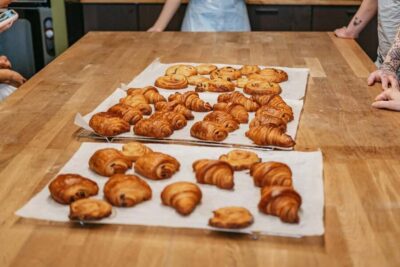
After the hands-on work, you get to enjoy what you made. The class includes a tasting on site, plus hot drinks and juice. That is a smart inclusion because it lets you evaluate your own pastries while the experience is still fresh.
Tasting is not just a reward. It becomes feedback. You notice texture, flavor, and the way the layers look and feel. That is how you connect technique to outcome.
Also, hot drinks and juice fit the petit dej vibe. It is not a heavy lunch break disguised as a class. It is breakfast culture, turned into an education moment.
Taking Your Viennoiserie Home (and How to Use the Recipe Sheet)
You take home the pastries you created. That is more than convenience. It gives you a reason to practice the next step: eating, assessing, and then trying again.
You also receive a recipe sheet after the workshop. That is key. At home, memories get fuzzy fast, especially with dough and timing. A written reference helps you repeat the process more accurately, instead of relying on vague recollection.
Practical advice for after the class: treat your first home bake as a second attempt, not a final exam. You are learning a dough system with multiple variables. If your first repeat is not perfect, that is normal. The real win is you now have the method, and you know what to adjust.
Price and Value: Is $112 Fair for a 2-Hour Paris Workshop?
The price is $112 per person for a 2-hour pastry workshop. In Paris, that is not the cheapest thing on a food list, but it also does not feel overpriced for what you get.
Here is why it can be good value:
- You get professional guidance throughout, not a quick demo.
- You receive all ingredients and equipment, which removes extra costs and planning.
- You get an on-site tasting, with hot drinks and juice.
- You take home pastries, plus a recipe sheet so the learning continues.
If you compare this to buying several pastries and a few drinks daily, the workshop can actually become a smart “pay once, learn skills” option. You are not just tasting the city, you are building a technique you can reuse.
Big picture: if you love food, enjoy hands-on activities, and want a skill you can take home, the price starts to make sense. If you only want to sample something sweet and do not care about technique, you might decide it is not the best use of your time.
Who This Workshop Suits Best (and Who Might Want Another Plan)
This class fits you if you:
- are a beginner who wants clear guidance for laminated dough basics
- enjoy learning how food works, not just eating it
- want a small-group experience in Paris, with up to 10 participants
- will appreciate learning in French and English
- like the idea of eating a true breakfast style meal during the activity
It may not fit you as well if:
- you want a long, slow deep training session. This is 2 hours, so the focus is on essentials.
- you expect a totally private lesson. The class supports private or small groups, but the standard experience is described as small-group.
One more thing I like: the workshop is aimed at “all foodies,” which usually means less intimidation. If you are nervous about cooking, that beginner-friendly tone can help you relax and learn.
Should You Book This Croissant and Pain au Chocolat Class?
If you want a morning activity that is genuinely useful, I would book it. This is not just about eating a pastry. It is about learning how layers and handling create the result you love.
You should especially consider it if you enjoy techniques like pastry puffing and you want a repeatable process. With chef Deborah guiding a small group, plus tasting and take-home pastries and a recipe sheet, you leave with something tangible, not just a memory.
If your schedule is tight, treat it like a breakfast appointment. It gives you structure, skill, and a full sensory payoff in 2 hours.
FAQ
What will I learn in the class?
You will learn the essentials for a French breakfast, specifically how to make croissants and pain au chocolat. The workshop covers the basics of pastry puffing, plus the techniques involved in flaking, shaping, and baking.
How long is the workshop?
The workshop lasts 2 hours.
Is the class suitable for beginners?
Yes, it is open to everyone and suitable for beginners.
What languages are available?
Explanations are available in French and English.
Is it a small group?
Yes. The class runs as a private or small-group experience, with up to 10 participants mentioned.
What is included for food and take-home items?
You get a tasting on site with hot drinks and juice. You also take home the pastries you created, and you receive a recipe sheet after the workshop.
Ateliers for an Afternoon
- Fragonard Paris: Mini Perfume Workshop
★ 4.5 · 1,924 reviews - Paris Cooking Class and Lunch with Wine plus Market Visit Option
★ 5.0 · 1,024 reviews - Paris Croissant Small-Group Baking Class with a Chef
★ 5.0 · 910 reviews - Paris: 2-Hour Perfume Creation Workshop
★ 4.8 · 731 reviews
Newest write-ups from Paris



Pastry and Macaron Classes, compared.
Montmartre Cheese, Wine & Pastry Guided Walking Tour
Read our review →
Award-Winning Paris French Bakery Experience — Le Marais, 4th Arr
Read our review →
Private Montmartre Food Tour with Wine, Cheese & Pastries
Read our review →
Paris French Sweets Tasting Tour with Pastries and Chocolates
Read our review →
Paris Croissant Small-Group Baking Class with a Chef
Read our review →
Browse the lists this tour appears in