
Reviewed · WORLD WAR TWO HISTORY TOURS
World War two : The Occupation of Paris
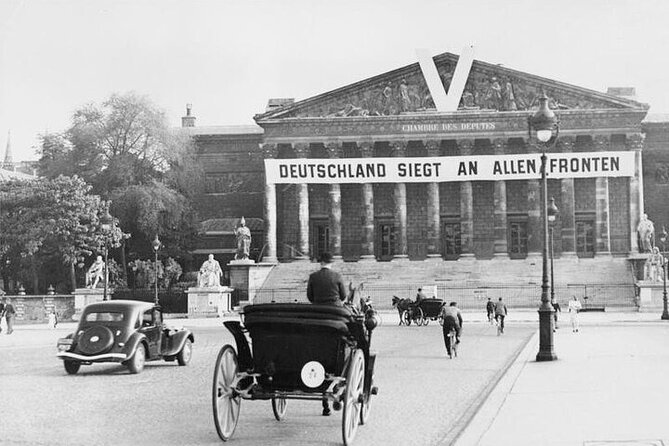
Paris during WWII is a bitter street lesson. This guide-led walk turns familiar landmarks into a clear story of how occupation changed daily life, politics, and culture. I especially like the local knowledge that makes each corner feel specific, and I like how the route mixes big moments with human-scale details you can actually picture.
The one possible drawback is pace. The stops are short, so if you want a long, lecture-style deep dive, you may wish there was more time at each site.
You also get practical comfort for a city walk: a small group (max 15), a mobile ticket, and English-speaking guidance. And because the guide handles the route, you can focus on what you’re seeing instead of figuring out where to go next.
In This Review
- Key highlights that make this walk worth your time
- A WWII Walk Through Real Paris, Not a Museum Hallway
- Bouillon Chartier Grands Boulevards: The War Comes to the Street
- Folies Bergère: Art Still Happens, Even When Power Controls It
- Passage Verdeau: Hidden Spaces, Requisitioned Rooms
- Hôtel Drouot: When Auctions Became a System for Looting
- Mairie du 9e Arrondissement: Resistance, Denunciations, and Passive Choices
- Banks and Armistice Politics at BNP Paribas, Maison Dorée
- Opéra Requisitions and Propaganda at Pathe Opéra Premier
- Place de l’Opéra Symbolism at BRED-Banque Populaire, Espace patrimonial
- Place Vendôme: Law, Resistance Networks, and the Ritz Factor
- Rue de Castiglione and the Hotel Headquarters Behind the Facades
- Place de la Concorde: Liberation Marks and an Art Storage Reality
- Price and value: What you get for $83.40
- Logistics that actually matter for this kind of walk
- Who should book this WWII Occupation of Paris walk
- Should you book?
- FAQ
- How long is the tour?
- Is it offered in English?
- Where do we meet and where does it end?
- How big are the groups?
- Do I need to pay entry fees at the stops?
- Will I have to navigate the route myself?
- Are service animals allowed?
Key highlights that make this walk worth your time
- A tight, guide-led route that keeps you moving without map math
- Everyday occupation details that go beyond famous dates and names
- Stop-by-stop context linking money, propaganda, and resistance in real places
- Cultural history under control, from theaters to movie-going life
- Small group size (15 max) that makes questions easier
More wartime Paris on foot:
- Paris WW2 The German Occupation Small group or Private tour
★ 4.5 · 128 reviews - Normandy D-Day Beaches and World War II Sites Day Trip from Paris
★ 4.5 · 56 reviews - Invalides Museum – WWI & WWII – Guided Tour up to 8 guests
★ 5.0 · 32 reviews - Skip-the-line Les Invalides World War Museum Guided Tour – Semi-Private 8ppl Max
★ 5.0 · 30 reviews
A WWII Walk Through Real Paris, Not a Museum Hallway
This is the kind of tour where you look up from the sidewalk and suddenly the buildings feel active. Occupation of Paris was not only tanks and decrees. It was also auctions, banks, movie theaters, and the politics of who got accused, who stayed quiet, and who helped.
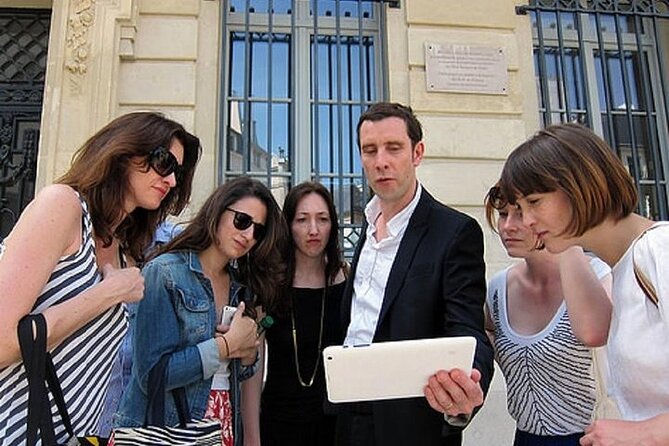
I like that the guide does the heavy lifting. You follow along and learn as you go, instead of losing time navigating or trying to read every plaque on your own. For a first-time Paris trip, that matters. You get bearings fast, then you can choose what to revisit later on your own.
And yes, you cover the dark stuff. The point is to make the occupation legible in the places where it happened, then carry that understanding with you as Paris goes on looking beautiful.
Bouillon Chartier Grands Boulevards: The War Comes to the Street
You start at 38 Bd des Italiens, 75009 Paris, and the walk begins with an immediate shift in tone. One of the early stops is Bouillon Chartier Grands Boulevards, where you get the story of how WWII began and how Paris moved into occupation.
What I find useful here is the framing. Instead of only talking about high-level strategy, the guide connects the start of the war to what changed for ordinary people. You also hear dramatic anecdotes and everyday life under occupation in the same breath.
It sets the pattern for the whole tour: a historical storyline tied to very specific street scenes. That is why this walk feels more like learning Paris than learning from a slideshow.
Folies Bergère: Art Still Happens, Even When Power Controls It
Next up, Folies Bergère. This is where the tour shows you a side of occupation people often forget: how intense artistic life continued, even under German control.
You hear about entertainment that stayed on stage, plus the draw of movie stars and music-halls. Under occupation, performance wasn’t just art. It was also public messaging, escape, and a kind of normal that did not mean normal.
Even with only about 7 minutes here, it works because the guide ties art to the reality of who had the authority and what that meant for what people could see and do.
Passage Verdeau: Hidden Spaces, Requisitioned Rooms
Then comes Passage Verdeau, one of those Paris passages that feels made for atmosphere. You learn that passages keep the look and feel of older Paris, including details that connect to the occupation era.
A key point is that, behind the cozy walk-through vibe, some spaces were used for purposes the occupiers imposed. The guide points out a building on the other side that was used as a bordello requisitioned by the German army.
This is one of the stops that sharpens your perspective. You start reading the city differently. A passage is no longer just cute. It becomes a reminder that the occupation could reach into the most tucked-away corners.
If this one is booked out, Paris has these too:
- Paris: 1-Hour Seine Cruise departing from the Eiffel Tower★ 4.4 · 77,472 reviews
- Disneyland® Paris 1-Day Ticket★ 4.6 · 49,412 reviews
- Paris: Versailles Palace and Gardens Full Access Ticket★ 4.6 · 41,579 reviews
- Paris: Arc de Triomphe Rooftop Tickets★ 4.6 · 34,264 reviews
Hôtel Drouot: When Auctions Became a System for Looting
At Hôtel Drouot, the tour shifts from streets and performances into commerce. During the occupation, a large amount of simple objects and art were sold through auction.
The guide explains the darker angle: how Jewish property was systematically stolen, and how that theft fed into official sales. There’s also a story about a German art dealer working for the Reich, which helps you understand how the occupation used people and institutions to legitimize what should never have been normal.
This is also a stop that can hit hard. But it’s exactly the kind of place where context matters. Seeing an auction house in peace-time is one thing. Learning how it functioned under occupation is another.
Mairie du 9e Arrondissement: Resistance, Denunciations, and Passive Choices
Next, you reach Mairie du 9ᵉ arrondissement de Paris, and the tone becomes more personal and civic. Here the guide brings in a local employee to talk about the Résistance.
You also hear about denunciating and passive resistance in France during WWII. That distinction matters, because it avoids the easy story of only heroes on one side and villains on the other. Real life is messy, and the tour makes room for that reality.
In about 10 minutes, you get a useful way to think about moral pressure. It helps you connect the big narrative of Liberation with the smaller, daily decisions people faced.
Banks and Armistice Politics at BNP Paribas, Maison Dorée
A surprisingly important stop is BNP Paribas | Maison Dorée. This is where the tour makes the economic side feel concrete instead of abstract.
You learn about the role of banks under occupation and how the armistice agreement between France and Germany shaped the political and economic situation. It’s one of the stops that explains why power is not only enforced by soldiers. It is also enforced through systems, paperwork, and financial structure.
For me, this is a big value moment. Many WWII tours focus on military events. This walk adds the money layer, which helps you understand how occupation could persist.
Opéra Requisitions and Propaganda at Pathe Opéra Premier
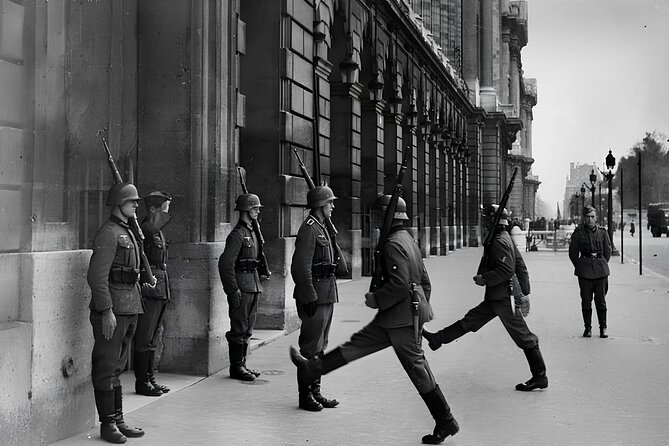
At Pathe Opera Premier, you get an example of a movie theater requisitioned for German soldiers. That detail is simple, but it lands. A theater is supposed to be leisure. Under occupation, it could become an occupying tool.
Nearby, the guide points to a famous exhibition linked to Nazi propaganda, with an antisemitic message. You hear about The Jews and France and how it was used to push antisemitic ideas.
This stop works because the tour ties culture to control. It also gives you a lens for what you see later in Paris: propaganda can hide in plain sight, especially when it’s packaged as spectacle.
Place de l’Opéra Symbolism at BRED-Banque Populaire, Espace patrimonial
Then the walk brings you to BRED-Banque Populaire – Espace patrimonial, with a strong focus on symbolism around Place de l’Opéra.
The guide connects the area to the Kommandantur and points out how places like the Opéra and Café de la Paix became associated with occupation anecdotes. The tour uses this to show how the occupation wasn’t just scattered. It had nerve centers, and the city’s most central spaces played roles.
This stop is about reading power in architecture and location. When you understand that, it becomes easier to understand why some neighborhoods feel different once you know their wartime use.
Place Vendôme: Law, Resistance Networks, and the Ritz Factor
Next is Place-Vendome, where you shift into a neighborhood of institutional power.
The guide talks about what happened to rue de la Paix jewelry stores, then expands to the law ministry being occupied by the German army. You also hear about one of the first resistance networks in the nearby area.
Then comes the Ritz Hotel angle. The guide explains how the Ritz was a key occupation site, with celebrities, spies, and military figures moving through its world.
Why I like this stop: it ties together three things that usually feel separate. Money, law, and intelligence. If you want a mental map of occupation power structures, this is one of the best places on the route.
Rue de Castiglione and the Hotel Headquarters Behind the Facades
You continue to Rue de Castiglione, and the tour explains how many palace hotels were used as headquarters of the German army.
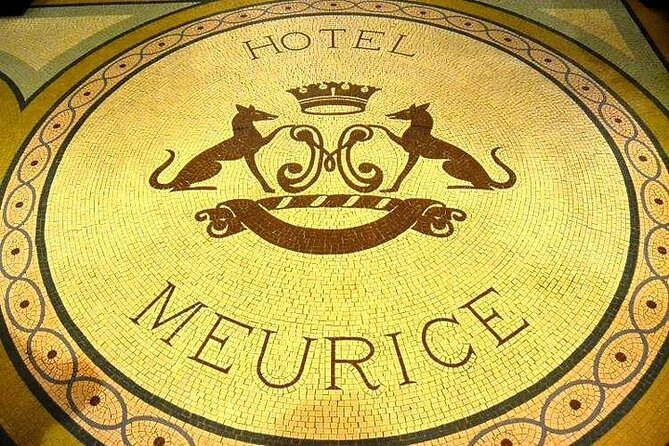
There is also a focus on the fight for Liberation linked to these headquarters. Behind Hotel Meurice, the guide discusses how conflicts tied to Liberation played out in and around these locations, including where fighting ended there.
This is where Paris feels like it has layers. The buildings look glamorous. Under occupation, they were also strategic platforms. The tour helps you hold both truths at once.
Place de la Concorde: Liberation Marks and an Art Storage Reality
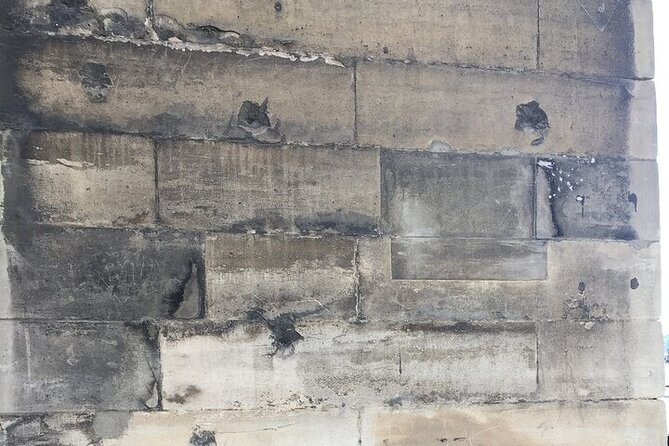
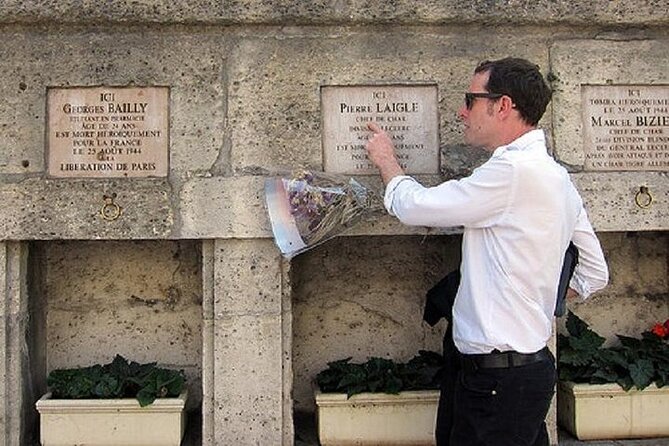
The walk ends at Place de la Concorde, right by Concorde métro station. Here the guide points out marks of Liberation fighting and how memorial plaques honor soldiers, Résistance fighters, and civilians.
The stop also includes a reminder that a museum behind the square was used by the Germans to store art stolen from Jewish families, then sent to Germany.
This final theme sticks. You don’t just leave with the sense of occupation as a story. You leave with the sense that the occupation had long shadows, including cultural loss that continued after the fighting.
And since it is the end point, you can roll straight into the rest of your day with a new lens for what you see around you.
Price and value: What you get for $83.40
At $83.40 per person, you are paying for a guided, structured narrative walk, not for museum tickets. Many stops list admission ticket free, and the tour is built around interpretation and route guidance.
Duration is about 2 hours 15 minutes, which is a reasonable chunk for a concentrated walking history session. The group limit is 15 travelers, which tends to keep it interactive and manageable in a busy city.
English is covered, and you get a mobile ticket. If you like to travel with light logistics and focus on learning, this format fits well. For the price, you are mainly buying the guide’s ability to connect locations into a coherent story.
The main value question is your learning style. If you want broad context in a short time, this tour can be a smart use of limited hours. If you want deep academic detail at each stop, you might find the time brief.
Logistics that actually matter for this kind of walk
You meet at 38 Bd des Italiens, 75009 Paris, and you finish at Place de la Concorde, 75008 Paris, close to Concorde métro station. The start time is 10:30 am, and the tour is designed for most travelers, with the guide leading the way so navigation stays off your plate.
Also, the tour allows service animals. It is near public transportation, which makes it easier to plug into the rest of your itinerary.
One practical tip: wear walking shoes. This is an urban history walk, and the story depends on moving between sites.
Who should book this WWII Occupation of Paris walk
This is a great fit if you:
- Want a first-pass understanding of how occupation worked across daily life, culture, and institutions
- Like walking tours where the guide handles the route and keeps you focused
- Prefer short stops with clear context rather than a single long museum visit
- Want to connect the dots for later self-guided exploration
It can also help if you like asking questions, since the maximum group size is kept small.
If you are the kind of traveler who expects a long, professor-style lecture with extended tangents at each stop, you might want to match expectations. The structure is built for breadth in a limited time.
Should you book?
I think this is a strong booking choice if you want a compact, guided way to understand occupied Paris in real places. The combination of culture (theaters, passages), institutions (banks, law), and liberation aftermath (Concorde plaques and art storage context) makes the tour feel more complete than a single-theme walk.
If you go in expecting a scripted, guided route with short stop windows, you will likely feel satisfied. If you want maximum depth at one site, you might want to pair it with one extra independent visit afterward, so you can linger where you felt the strongest pull.
If you are trying to decide what to do with a couple of hours in Paris and you care about meaning, not just photos, I would book it.
FAQ
How long is the tour?
The tour lasts about 2 hours 15 minutes.
Is it offered in English?
Yes, the tour is offered in English.
Where do we meet and where does it end?
You meet at 38 Bd des Italiens, 75009 Paris, and the tour ends at Place de la Concorde, 75008 Paris, right next to Concorde métro station.
How big are the groups?
The maximum group size is 15 travelers.
Do I need to pay entry fees at the stops?
Each stop listed shows admission ticket free, so you are not paying separate entry fees for those particular sites during the walk.
Will I have to navigate the route myself?
No. Your guide leads the way, so you do not have to navigate.
Are service animals allowed?
Yes, service animals are allowed.
Newest write-ups from Paris



World War Two History Tours, compared.

Paris WW2 The German Occupation Small group or Private tour
Read our review →
Normandy D-Day Beaches and World War II Sites Day Trip from Paris
Read our review →
Invalides Museum – WWI & WWII – Guided Tour up to 8 guests
Read our review →
Skip-the-line Les Invalides World War Museum Guided Tour – Semi-Private 8ppl Max
Read our review →Paris 2-hour WWII Walking Tour: Occupation history
Read our review →
Skip-the-line Les Invalides World War Museum Guided Tour – Exclusive Guided Tour
Read our review →
WWII American Landing Beaches Discovery Private Tour
Read our review →
A Day in Normandy Landing Beaches of WWII with Private Guide
Read our review →Browse the lists this tour appears in