
Reviewed · COVERED PASSAGE WALKS
Treasure Hunt in Paris: “Under the Covered Passages”
In a city of statues, this game makes you look down and move. Under the Covered Passages turns iconic Parisian corridors into a 1825-style murder hunt, with you and your team chasing clues through famous passageways and gardens. I especially like the hands-on puzzle format and the way it nudges you to notice details you would normally walk past. One thing to keep in mind: the experience is French-led, so non-French speakers may find parts slower or harder.
You start with a quick presentation that sets the scene fast, then get a logbook to work through clues as you go. I like the team setup, with groups of 3 to 6, because it keeps everyone involved without turning it into a solo scavenger hunt. The main drawback is that some sections rely on questions that help you progress, not just the mystery solving, so the balance may feel a bit uneven if you only want pure detective work.
If you enjoy light competition, teamwork, and that moment when a clue clicks, this is a fun way to spend 2.5 hours in Paris. Expect the story to drive the pace, and the covered passages to make the whole route feel like a different Paris, quieter and more sheltered than the big streets.
In This Review
- Key things to know before you go
- A 1825 murder hunt that keeps you moving
- Where you start: Square Montholon in the 9th
- Passage Verdeau: your first real clue check
- Passage Jouffroy: teamwork wins over solo brilliance
- Galerie Vivienne: where the game becomes sightseeing
- Palais-Royal Garden: the story builds toward the finish
- Price and value: what $17 buys you
- Best fit: who will enjoy this most
- The people factor: guides set the tone
- Should you book Under the Covered Passages?
- FAQ
- How long is Under the Covered Passages?
- Where do we meet for the treasure hunt?
- What language is the tour hosted in?
- Is it wheelchair accessible?
- What age is the treasure hunt suitable for?
- How does it work if I’m traveling alone or as a couple?
Key things to know before you go
- A story-driven “detective” setup in 1825 that keeps you focused on the route
- Logbook + clue questions that turn sightseeing stops into a game
- Teams of 3 to 6 (with singles or couples added to a team) so you are never alone
- Covered passage stops plus Palais-Royal Garden before finishing at Colonnes de Buren
- French guide and some content shown in its original language
- Wheelchair accessible route and format
More of the covered passages:
- Paris: Covered Passages Walking Tour
★ 4.6 · 128 reviews - Paris Covered Passages Walking Tour plus Seine Cruise Option
★ 5.0 · 118 reviews - Discover Secret Passages in Paris
★ 4.7 · 26 reviews - Covered passages: secrets, luxury and modernity
★ 5.0 · 11 reviews
A 1825 murder hunt that keeps you moving
This isn’t a museum tour where you sit and listen. It is a guided treasure hunt with a storyline that starts like something out of a dramatic novel. You are recruited into Vidocq’s gang, and the mystery begins with a man crawling under the arches of the Palais-Royal after a gruesome scene. It is dramatic on purpose. That drama is what makes the walking feel like part of the action instead of just moving between stops.
You get a brief intro at the start, then a logbook that becomes your main tool. You will follow clues, answer questions, and solve the puzzle before other teams. It is not about being the fastest tourist with the best phone map skills. It is about observation and deduction, using the route itself as your “evidence board.”
I also like the practical realism of the structure. You are in teams, not in a big group mob. The format gives you a reason to talk to each other, compare theories, and decide which clue to trust. That matters because covered passage sightseeing can otherwise turn into polite wandering. Here, you have a job.
One consideration: because the host is French and some content is shown in its original language, the game’s momentum can depend on how comfortable you are with French. If you can read French questions and follow short instructions, you will likely enjoy the flow more. If not, you might still have fun with the visuals and teamwork, but you may feel stuck on the text at key moments.
Where you start: Square Montholon in the 9th
Your meeting point is straightforward: your guide waits in the center of Square Montholon, in Paris’s 9th arrondissement. That location matters because it makes the hunt feel like a guided route through central Paris rather than a random drop-off.
From there, the tour moves quickly from the intro into the first stretch of the game. You will get a visit and sightseeing segment early on, around 15 minutes. Think of that as your warm-up. It sets your rhythm for the rest of the investigation: read the clue, locate the relevant spot, talk it through, and keep moving.
Practical tip: bring something comfortable to write with if your logbook instructions encourage note-taking. Also, assign roles right away inside your team. One person reads, one person looks, and one person double-checks the logic. It sounds silly, but teams that do this tend to solve faster and feel less stressed.
Passage Verdeau: your first real clue check
The next stop is Passage Verdeau, about 15 minutes. This is where you move from the initial story energy into working the puzzle for real. The time is short enough that you will likely feel the sense of urgency. That is good. It prevents the game from dragging.
At this stage, the main value is how the covered passages change your pace. Instead of broad sidewalks and loud intersections, you are walking through sheltered corridors where people naturally slow down and look closer. The hunt basically rewards that instinct. You should use this first major passage stop to practice the investigation habits you will need later: slow your pace for clues, then speed up to keep the team from falling behind.
Possible snag: if your team is evenly split on interpretations, you may waste time re-reading the same clue. If your logbook allows it, mark the answer you think is most likely, then keep moving. You can circle back in your head later if the logic improves.
Passage Jouffroy: teamwork wins over solo brilliance
Then it is Passage Jouffroy for about 20 minutes. This is a longer stop, enough time to actually test your assumptions. In a puzzle hunt, that extra time can feel like permission to debate. It is also a good moment to check that everyone understands what the team is trying to prove.
This stop is valuable for the social part of the experience. In a group of 3 to 6, you need shared momentum. If you are traveling with friends, this is where you can have that fun back-and-forth, like mini courtroom drama, but with kinder stakes.
If you are a couple or a small party, you join a team. That can be a plus if you enjoy meeting people and sharing ideas. It can also mean you should be ready to adjust your preferred pace. The format does not let one person dominate, and that can be either enjoyable or annoying depending on your style. Most people will find it balances out.
Other puzzle hunts around Paris:
- Who Killed Victor ? Escape Game at Père Lachaise Cemetery★ 4.8 · 258 reviews
- Escape Hunt Paris, Escape Game★ 4.5 · 122 reviews
- Romantic Montmartre: Paris Lost Lovers Exploration Game and Tour★ 4.5 · 107 reviews
- Louvre Museum Guided Family Treasure Hunt★ 5.0 · 78 reviews
Galerie Vivienne: where the game becomes sightseeing
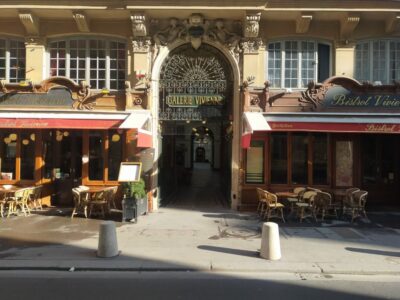
Next comes Galerie Vivienne, around 20 minutes. This is where the hunt starts to blend detective work with real Paris wandering. You are still solving questions, but you are also experiencing the passage atmosphere as a destination in itself.
I like this stage because it helps you connect the dots between locations. By now, you have a few clues under your belt and you can see how the route is structured like an investigation. Instead of guessing randomly, you start looking for patterns in the way the logbook pushes you from one place to the next.
If you get stuck here, do not panic. In many puzzle tours, the earlier clues help you interpret later ones. You can also ask your team host or follow instructions carefully during the visit portions. The key is to keep the team moving, not get stuck in a single question for too long.
Palais-Royal Garden: the story builds toward the finish
After the passages, the hunt shifts to the Palais-Royal Garden, about 25 minutes. That longer block of time is interesting because it slows the pace just a bit. It is still part of the game, but the setting changes how you notice things. Gardens tend to encourage calmer attention, which can help when you are doing deduction instead of sprinting for answers.
This is also where your earlier logic should start paying off. If your team keeps track of what you answered and why, you will likely move through this stage with more confidence. The logbook tends to reward consistency, because clues typically link across stops.
You will then finish at Colonnes de Buren / Les Deux Plateaux. That end point is a visual “arrival moment,” a place where the whole story feels like it lands with purpose. Even if you did not solve every question, reaching the finish line gives you closure and lets you compare answers with your team in the last moments.
Price and value: what $17 buys you
At $17 per person for about 150 minutes, this is a strong value for a structured, guided activity in central Paris. You are paying for more than walking with a guide. You get a roadbook/logbook, investigation materials, and a live game host who guides the experience in French.
Where this price feels especially fair is in the mix of benefits:
- You get historic places visited as part of the game format.
- You have a clear time block of 2.5 hours, which is useful when planning a tight Paris day.
- You get built-in social energy with teams of 3 to 6.
Is it a bargain compared to a standard guided walk? It depends on your travel style. If you hate puzzles and prefer pure sightseeing with minimal pressure, this might feel like overkill. But if you like the idea of turning covered passages into an interactive story, the $17 cost looks like a bargain for the time and structure you receive.
Best fit: who will enjoy this most
This is ideal for friends or family who want an active outing. Reviews tied to this kind of experience often come from people who already know Paris a bit but want a different angle. If you have visited famous landmarks, a game that leads you through passages you may not have explored before can feel refreshing.
It is also a great option if you enjoy:
- solving clues in a group
- moving at a steady pace instead of stopping every five minutes
- learning through context rather than reading museum panels
Age guidance: the game is suitable for ages 15 and up, and minors must be accompanied. If you are traveling with teens, this can work well because it feels like an adventure, not a lecture.
Language note: content is French-led, and some content is shown in its original language. If your French is basic but you can follow along and work as a team, you will likely still enjoy it. If your French is limited, plan for a more teamwork-driven experience where you rely on group members, and you might not catch every nuance.
The people factor: guides set the tone
A big part of the experience comes down to the host. You may encounter guides like Alexis and Thimotée. In the past, guests have highlighted the guides as friendly and welcoming, and that matters here because a game needs a smooth start. If the intro is clear, you waste less time and the puzzles feel more solvable.
You do get a live host in French. That does not mean you cannot participate if you are not fluent, but it does mean you should expect the explanation and progression to come primarily in French. The best approach is to arrive ready to focus, not just ready to listen.
Should you book Under the Covered Passages?
Book it if you want a 2.5-hour, story-driven outing that mixes sightseeing with puzzles and teamwork. At $17, it is priced like an accessible activity but structured like a real tour, with a logbook and a defined route. It is especially worth it if you like walking routes that feel sheltered, like Paris in side corridors rather than out in the full street noise.
Skip it if you want a purely informational tour with minimal text and minimal puzzle pressure. Also skip it if you know you cannot comfortably follow French instructions or questions. Because the game relies on a French host and some original-language content, you would likely feel frustrated rather than entertained.
If you do decide to go, go with a team mindset. Assign roles, keep your logbook answers organized, and treat each stop as a clue checkpoint. You will get more out of it, and the ending at Colonnes de Buren / Les Deux Plateaux will feel like a real finish, not just another place you happened to walk past.
FAQ
How long is Under the Covered Passages?
The experience lasts about 150 minutes.
Where do we meet for the treasure hunt?
You meet in the center of Square Montholon in Paris, in the 9th arrondissement.
What language is the tour hosted in?
The game host is in French, and some content may be shown in its original language.
Is it wheelchair accessible?
Yes, the experience is listed as wheelchair accessible.
What age is the treasure hunt suitable for?
The game is suitable for ages 15 and up, and minors must be accompanied.
How does it work if I’m traveling alone or as a couple?
Singles or couples join a team. Each group of 3 or more is guaranteed to form a team, with no other person added to your team.
Newest write-ups from Paris





Covered Passage Walks, compared.
Paris Covered Passages Walking Tour plus Seine Cruise Option
Read our review →
Covered passages: secrets, luxury and modernity
Read our review →
Paris Covered Passages Small-Group Walking Tour with Wine Tasting
Read our review →


Paris Covered Passages Treasure Hunt — Self-guided Game
Read our review →Browse the lists this tour appears in